Tokenization
Series: Own Your Tokens — Part 1 of 3
Every conversation about payment tokenization starts in the wrong place.
It starts with the token. It should start with the PAN.
The Primary Account Number — the 16-digit card number your customer enters at checkout — is the most sensitive data point in your entire payment stack. It identifies the card scheme, the issuing bank, and the individual cardholder account. Every authorization request, every chargeback, every stored payment instrument is ultimately anchored to it.
And in most merchant stacks today, it sits with someone else.
That's not a bug. It's how payment infrastructure has been architected for decades — and it creates a dependency that outlasts any contract term, any pricing negotiation, any promise of flexibility your PSP has made.
This article covers the foundation: what the PAN actually is, why its custody determines your strategic independence, what tokenization means at an architectural level, and how PCI-scoped vault ownership is the first decision that either locks you in or sets you free.
What the PAN Actually Controls
The PAN is a structured number. The first six digits — the Bank Identification Number (BIN), formally the Issuer Identification Number (IIN) — identify the card scheme and issuing institution. The next nine digits are the individual account number. The final digit is a Luhn checksum.
That structure means the PAN carries information at multiple levels simultaneously: which network to route to, which issuer to authorize against, and which specific customer account to debit. Every downstream system in your payment stack — routing engine, fraud tool, loyalty platform, analytics layer — references the PAN either directly or through a surrogate.
This creates three levers of strategic control that PAN ownership directly determines:
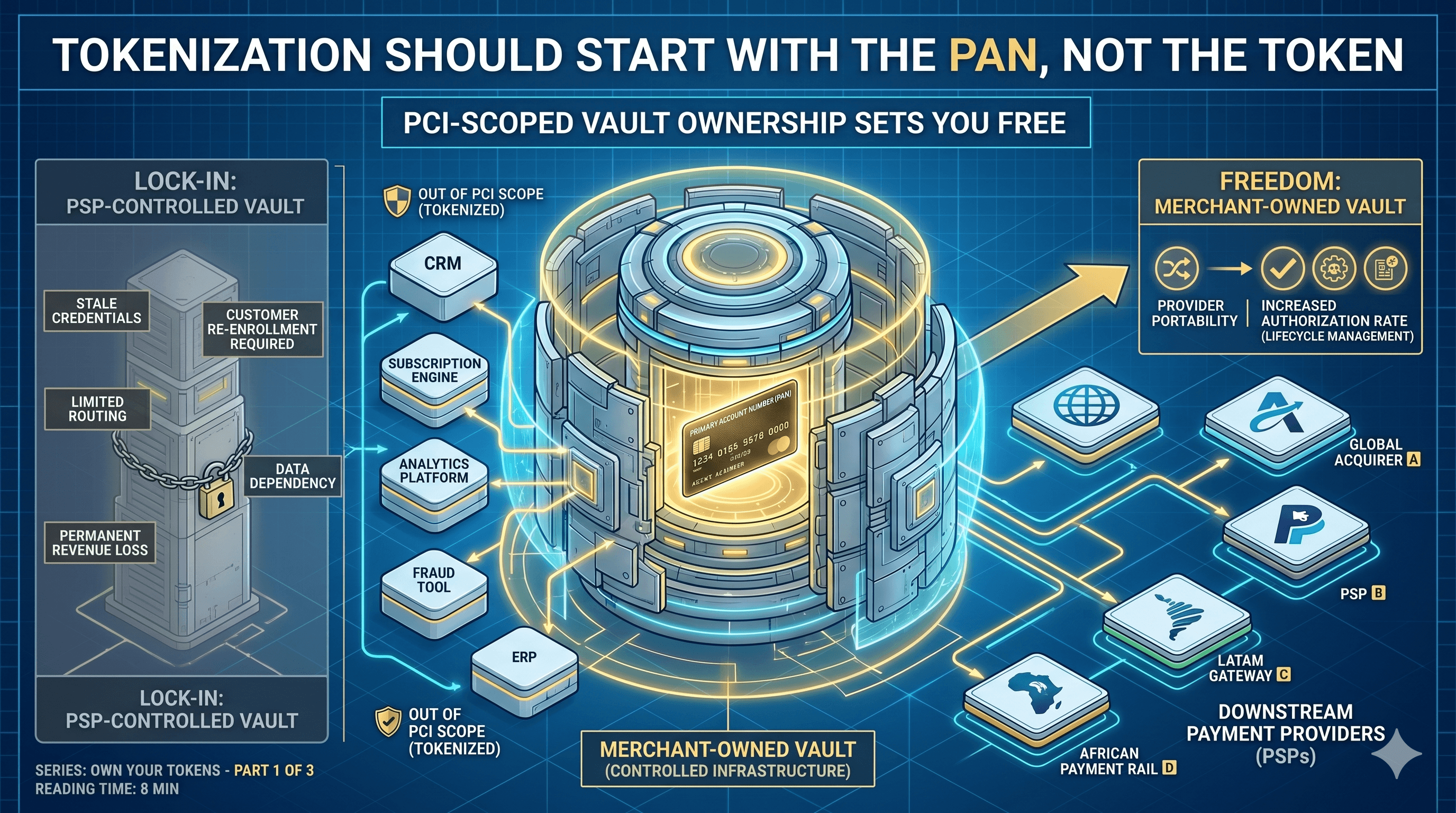
PSP portability. Without control over stored PANs, switching payment providers requires re-collecting card credentials from every stored customer. In practice, a meaningful percentage of customers won't complete re-enrollment. That's permanent revenue loss — not a transition cost. With PAN ownership, provider migration is an infrastructure change, not a customer-facing event.
PCI compliance scope. PCI DSS is fundamentally a data custody framework: the rules follow the PAN. Every system that stores, processes, or transmits a PAN is in scope. Isolate the PAN in a single, controlled vault, and every other system — CRM, ERP, subscription engine, analytics platform — steps out of scope entirely. The compliance surface collapses to one component.
Authorization rate. Token quality is a direct function of PAN lifecycle management. Stale credentials, mismanaged card updates, poor token hygiene — all of these silently degrade authorization rates. Who manages the underlying PAN determines whether your token infrastructure is an asset or a liability.
What Tokenization Actually Means
Tokenization is the act of replacing the PAN with a surrogate value — a token — in all systems except the one responsible for holding the actual card data.
The token is inert by itself. It has no monetary value. It carries no cardholder information. If it's exfiltrated, it exposes nothing. That's the security benefit.
But here's the architectural reality that most vendor conversations skip entirely:
Somewhere, a mapping table connects every token back to the underlying PAN. Without that table, no authorization can be initiated. The vault that holds the mapping table is where the real power sits — not in the token itself.
The question is not: do you have tokens? Every PSP will tell you yes.
The question is: who holds the mapping table?
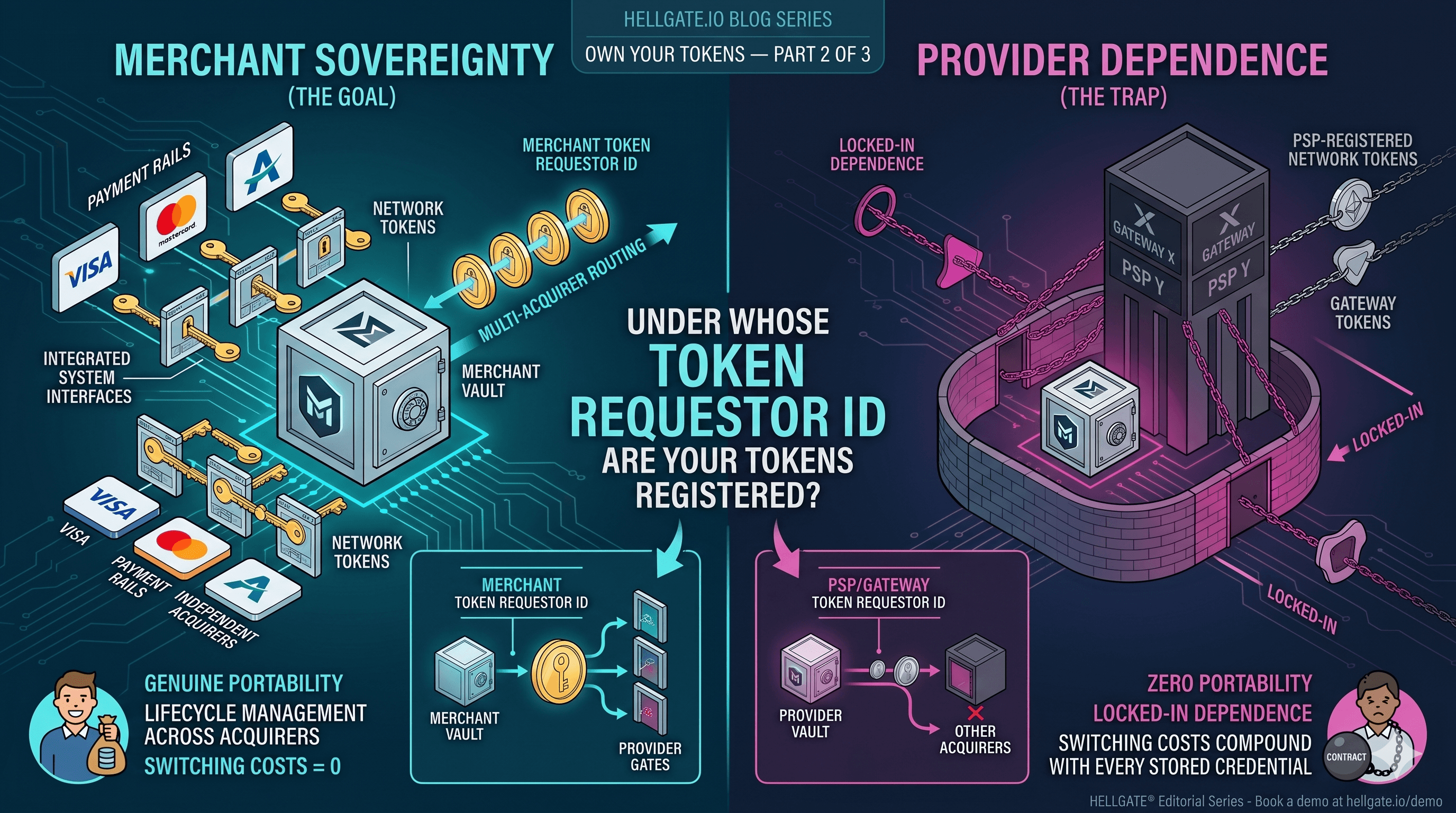
If your PSP holds it, your tokens are PSP-specific. They don't travel. They don't port. Switch providers and you're starting from scratch — re-enrolling customers, re-collecting credentials, rebuilding stored payment instruments.
If you hold it — or a dedicated infrastructure provider holds it under your exclusive control — your tokens are yours. The mapping table is an asset you control. Provider changes become routing decisions, not re-enrollment events.
This single architectural distinction separates a tokenization strategy that reduces compliance burden from one that actually gives you control over your payment infrastructure.
PCI Tokens: Compliance Is Not the Same as Control
PCI tokenization is the most widely deployed form of payment tokenization. The concept is straightforward: remove the PAN from every system except the vault, reduce your PCI DSS scope to that one component, and let the rest of your infrastructure operate on tokens.
The compliance benefit is real and substantial. A merchant operating a PCI-compliant vault can legitimately exclude its CRM, data warehouse, subscription billing engine, and fraud tooling from PCI scope entirely. That's meaningful: fewer systems to audit, lower certification overhead, reduced exposure surface.
But compliance and control are not the same thing. And the PCI tokenization model, as implemented by most PSPs, conflates them in ways that harm merchants.
The vault ownership question
When your PSP offers PCI tokenization, they are typically offering to operate the vault on your behalf. That sounds like a service. It is, in part. But it also means:
The token-to-PAN mapping table resides in their infrastructure
Your tokens are issued within their token domain — not a portable standard
Token validity is contingent on your continued relationship with that provider
Exit means token invalidation — which means customer re-enrollment
The PCI scope reduction is identical in both the PSP-vault and merchant-vault models. Your compliance posture is the same. But the power structure is entirely different.
Merchant-controlled vaulting
The alternative is a vault that operates under your control — either infrastructure you operate directly, or a dedicated third-party vault provider whose contractual relationship is with you, not your acquirer.
In this model:
The mapping table is yours
Tokens are portable across any downstream PSP or acquirer
Provider transitions are routing changes, not data migration events
A new acquirer relationship doesn't require re-collecting a single stored credential
This is the architecture that makes payment composability real. It's the difference between reducing your compliance burden and actually owning the infrastructure that underlies your customer payment relationships.
The Two Questions That Reveal Everything
Before any tokenization conversation with a provider goes further, two questions cut through the pitch:
Where does the token-to-PAN mapping table physically reside, and under whose contractual control?
What happens to our stored tokens if we terminate this contract?
If the answers are "in our infrastructure" and "they become inaccessible" — you know exactly what you're buying. It may still be the right commercial decision. But it should be a deliberate one, not a default.
What Comes Next
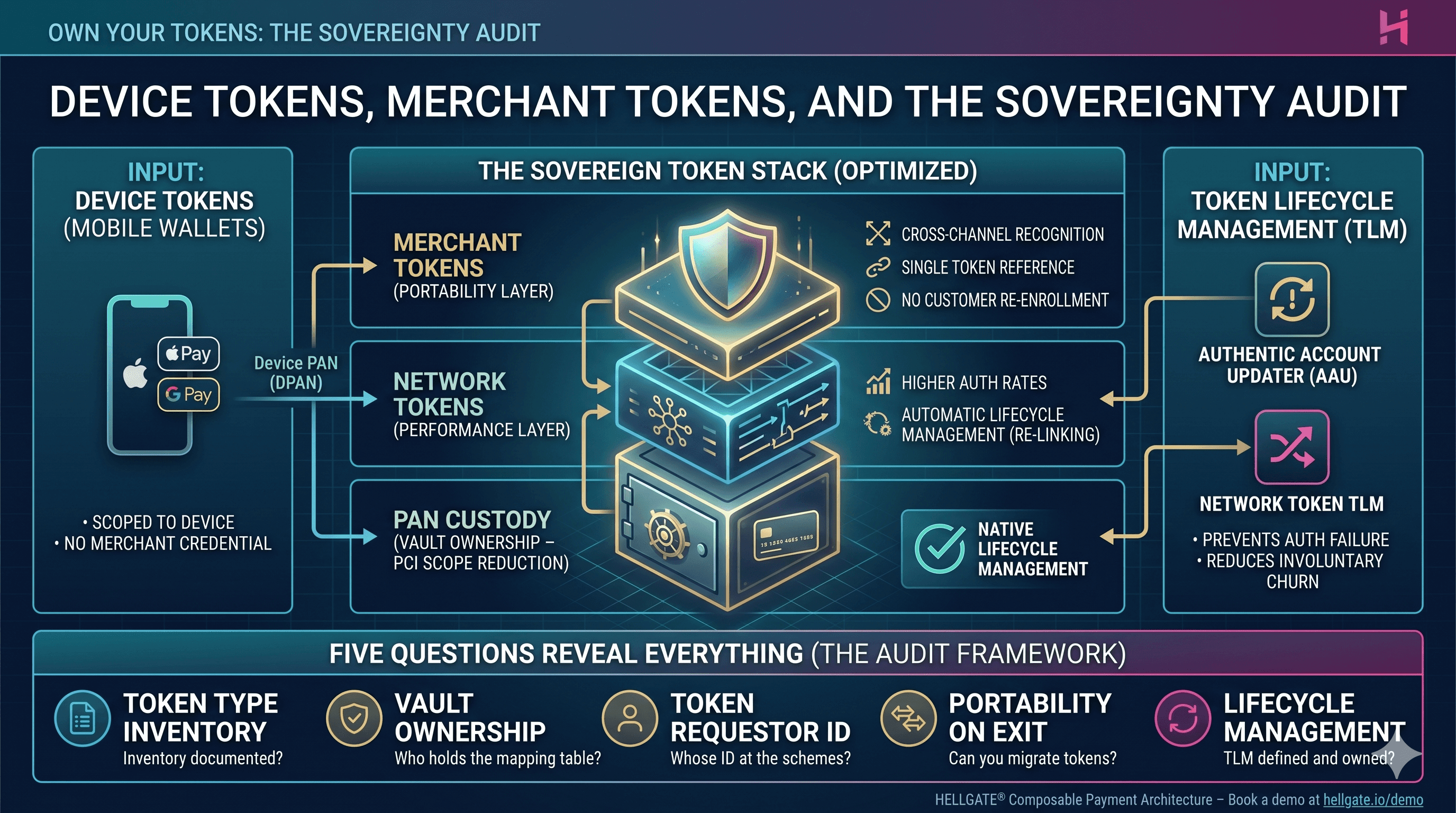
Token types differ in more than just who holds the mapping table. Network Tokens, Scheme Tokens, Gateway Tokens, Device Tokens, and Merchant Tokens each have fundamentally different validity scopes, portability profiles, and lifecycle behaviors — and the industry has developed a reliable pattern of presenting weaker token types as stronger ones.
The next article covers the token types that actually move at network level: Scheme Tokens issued through Visa Token Service and Mastercard MDES, and the Network Token model built on top of them — including the structural trap embedded in how most providers deliver "Network Token" access.
Own Your Tokens is a Hellgate® editorial series on payment tokenization, credential sovereignty, and the architectural decisions that determine who controls your payment stack.
Book a demo at hellgate.io/demo — or read the technical documentation at developer.hellgate.io.
Jens Kohnen was driven to co-start the company by the conviction that payment infrastructure should empower businesses, not bind them. Recognizing that many large organizations were locked into monolithic, opaque setups, Jens embarked on a journey to free enterprises from these rigid stacks. His mission is to enable companies to regain full ownership and monetize their flows, transforming payments from a cost center into a strategic lever for growth.