Backend agnostic
Sub-millisecond local rules
API and Interceptor
Dedicated infrastructure
https://hellgate.io/specter
Built on the Hellgate Cloud Platform. Works with the fraud backends you already trust.
Visa Decision Manager
FraudSight by Worldpay
Bring your own backend
The problem
Fraud tooling forces bad trade-offs.
Most risk stacks make you choose between speed, accuracy, and flexibility. You should not have to.
Locked to one provider
Single-vendor fraud stacks bind you to one model and one latency profile. Switching means re-integrating everything from scratch.
Speed versus accuracy
Synchronous backend calls add latency to checkout. Skipping them to stay fast leaves weaker, blunter decisions.
Rigid rule engines
Static rules cannot express fallback, parallel scoring, or shadow testing without custom code and brittle glue.
Why Specter
One decision layer between you and every risk backend.
A universal risk and fraud prevention system, built for the complex part of the payments world.
Merchant
Specter
Rules and orchestration
Risk backends


Low latency by design
Backend agnostic, delivered as managed dedicated infrastructure. Local rules run in well under a millisecond.
Combine any backends
Integrates with any risk backend and merges them into sophisticated rulesets you control.
One simple integration
A single one-shot integration covers both classic pre-auth and transparent interceptor scenarios.
Integration
Two ways to plug in. Both invisible to your customers.
Call Specter directly, or slot it transparently between your gateway and acquirer.
API mode
A direct call to Specter’s decision API with an immediate response.
Request a decision, receive Allow, Review, or Block
Local rules always run synchronously and fast
Backends run sync, async, or in shadow mode
Interceptor mode
Specter is hooked transparently between your gateway and acquirer.
No change to your customer-facing flow
Transparent mode forwards every request and records results
Active mode forwards only when the decision is Allow
PATTERN 01
Synchronous pre-auth
Request a decision, apply rules and backends, then authorize on the result.
PATTERN 02
Async with delayed capture
Return a provisional decision instantly, finalize backends async, then capture or cancel.
PATTERN 03
Transparent interceptor
Forward to the acquirer while backends score in shadow mode for safe rollout.
PATTERN 04
Active interceptor
Forward to the acquirer only when the decision outcome is Allow.
Ruleset engine
Compose rules the way real risk teams think.
Rulesets run consistently, with very low latency, against every decision.
Local rules
Match values and ranges, run velocity calculations, and enforce maintained blocklists. All synchronous, all blazing fast.
match
range
velocity
blocklist
Backend orchestration
Group backends and combine them with fallback, parallel, or weighted split strategies inside a single ruleset.
fallback
parallel
split
groups
Shadow mode
Run a backend and record its result without acting on it. Validate new models safely in production.
~300 µs
Median local decision
3
Outcomes: Allow, Review, Block
20+
Tools for AI agents over MCP

Decision lifecycle
From first decision to chargeback, in one system.
Every decision resolves to one of three outcomes. Report the events that follow, and Specter feeds them back to refine models and maintain blocklists automatically.
Authorization
Void
Refund
Chargeback
Fraud
Allow
Review
Block
Inside Specter
See every decision. Tune every rule.
A console built for risk teams, from live decisions down to the rule that fired.
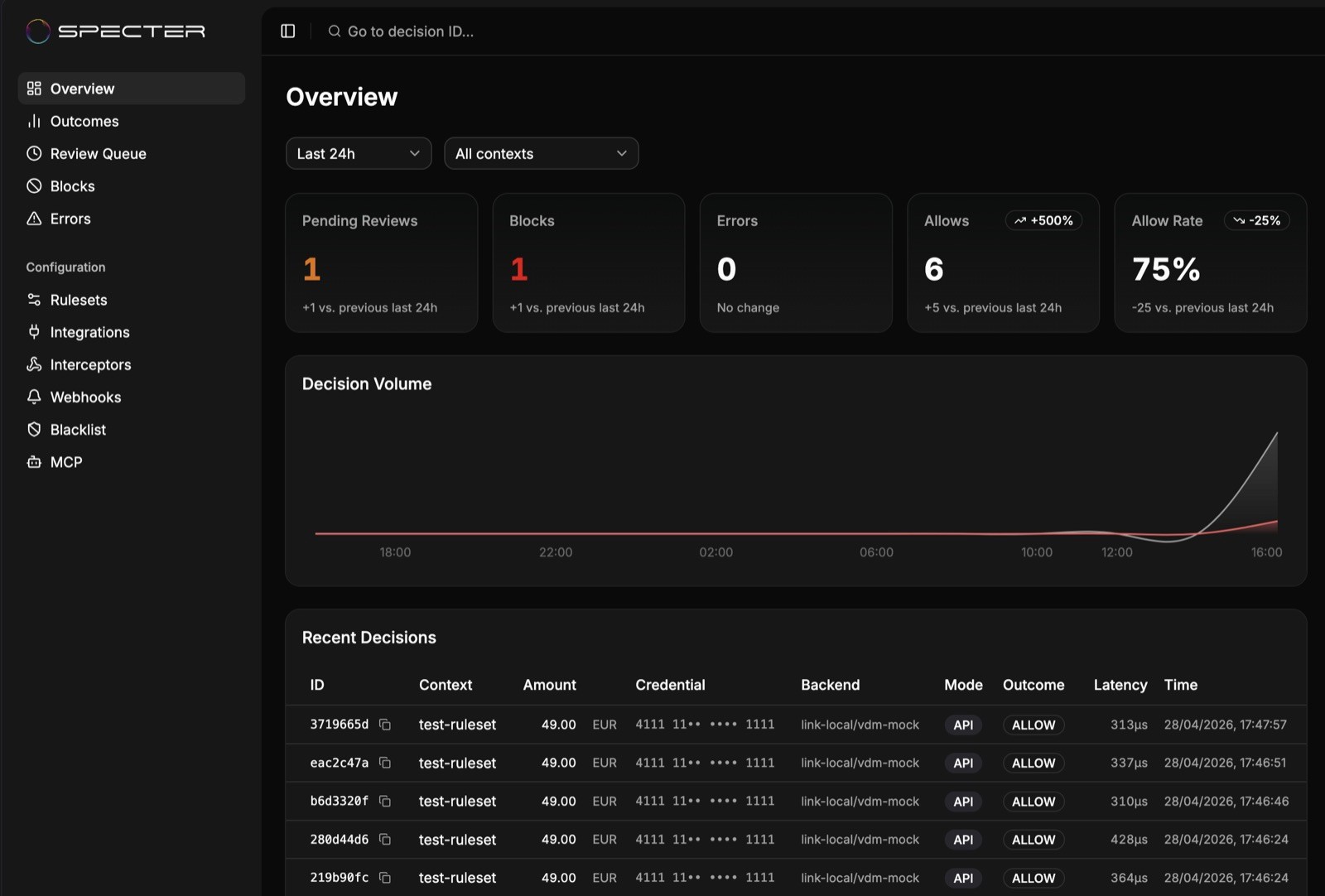
A live view of every decision
Track pending reviews, blocks, errors, and allow rate at a glance, with decision volume and the latest decisions streaming in.
- Filter by time window and context
- Per-decision latency in microseconds
- Jump straight to any decision ID
Composable
One product in the Hellgate Cloud Platform.
Run Specter on its own, or compose it freely with other Hellgate products as your needs grow.
You are here
Specter
Real-time risk and fraud decisions.
Guardian
Token vault with network tokenization.
Link
Rapid protocol and backend integration.
Pricing
Pricing scales with capacity, not with the number of checks you run.
Pick an infrastructure tier, add the backends you need, and compose with other Hellgate products. Transaction counts exclude backend checks.
Fixed monthly subscription. No per-decision charges.
S
Small
€3,500
/ month
Production tier
2.5M transaction checks per year included
Real-time decision engine - every transaction scored
Local rules engine – fraud prevention and business rules
Blocklisting with TTLs
Both integration patterns - decision API + interceptor
Backend-agnostic scoring - shadow & combined modes
External risk-engine backends (Link) included at every tier under this packaging.
Composable with the full Hellgate stack
M
Medium
€7,500
/ month
Production tier
15M transaction checks per year included
Real-time decision engine - every transaction scored
Local rules engine – fraud prevention and business rules
Blocklisting with TTLs
Both integration patterns - decision API + interceptor
Backend-agnostic scoring - shadow & combined modes
External risk-engine backends (Link) included at every tier under this packaging.
Composable with the full Hellgate stack
Most popular
L
Large
€20,000
/ month
Production tier
25M transaction checks per year included
Real-time decision engine - every transaction scored
Local rules engine – fraud prevention and business rules
Blocklisting with TTLs
Both integration patterns - decision API + interceptor
Backend-agnostic scoring - shadow & combined modes
External risk-engine backends (Link) included at every tier under this packaging.
Composable with the full Hellgate stack
No setup or onboarding fees.
Prices shown are list prices for orientation. Larger deployments follow the same model at a higher size, priced individually. Talk to us for custom pricing.
Optional external risk engines
If you choose to call engines such as Visa Decision Manager or Ravelin, those calls are billed by usage, based on whether and how much you use them. Local rules and decisions carry no per-decision fee.
Fixed infrastructure pricing.
You run a dedicated instance, priced as a fixed monthly fee by size.
No setup or onboarding fees.
No pricing by payment volume or transaction count.
FAQ
Questions, answered.
How fast are decisions?
Local rules run in well under a millisecond, with median local decisions around 300 microseconds. Backends can run synchronously, asynchronously, or in shadow mode, so you choose the latency and accuracy trade-off per rule.
Do I have to replace my fraud provider?
No. Specter is backend agnostic. Use Visa Decision Manager or FraudSight by Worldpay out of the box, or bring your own backend contract on the higher tiers.
How do I integrate?
Two ways. Call the decision API directly, or run Specter as a transparent or active interceptor between your gateway and acquirer. Neither changes your customer-facing flow.
What is shadow mode?
A backend runs and records its result without affecting the live decision. It lets you validate new models and providers in production before you trust them.
Is Specter PCI compliant?
Yes. Tiers cover SAQ A through SAQ D and Report on Compliance, running on dedicated infrastructure provisioned for you.
Can AI agents use Specter?
Yes. The Model Context Protocol integration exposes more than 20 tools, so Claude and other agents can query decisions, manage rulesets, and run investigations. It is available on the No-limit tier.
BOOK A DEMO
Walk through a live ruleset with our team. We'll map your fraud flows, show you how local rules and external backends combine into a single decision, and find the integration path that fits your stack.
Review of your current fraud setup and risk flows
Live ruleset walkthrough — local rules, velocity counters, and external backends
Integration options: Decision API or transparent interceptor proxy
Live Q&A with a risk engineer



Book your demo with our risk engineers
Trusted by enterprise clients








What is Hellgate Specter?
Specter is Hellgate's real-time fraud intelligence layer – a low-latency, high-throughput decision engine that analyses every transaction as it moves through your payment flow, assigns a risk score, and blocks bad actors before checkout. It combines fast in-process rules with integrations to external risk services, and improves detection over time by ingesting transaction data.
Like every CPA component, Specter runs standalone or composed with other services.
Label
What data does Specter analyze?
Specter evaluates signals such as device fingerprinting, geolocation, behavioural velocity (rolling-window counts per card, customer, device, or IP), and token-level data – without ever exposing sensitive card details. These feed both in-process rules and external risk backends.
The combination lets Specter catch patterns typical of fraud – unusual velocity, mismatched geographies, high-risk device signals – while keeping sensitive data protected.
Label
How does Specter prevent chargeback fraud?
Specter assigns a real-time risk score (0–100) to every transaction as it moves through Hub. For chargeback-prone patterns – first-time customers, high-value orders from high-risk geographies, unusual velocity – it triggers configurable policies: stepped-up verification, 3-D Secure enforcement, or outright blocking. The score draws on device fingerprinting, geolocation, behavioural velocity, and token-level signals.
Because Specter integrates natively as a CPA component rather than a bolted-on API, its scoring feeds directly into routing and decisioning with zero added latency.
Label
What fraud-detection backends does Specter support?
Specter is backend-agnostic. It integrates with external risk engines – such as Visa Decision Manager, Worldpay FraudSight, Ravelin, and Featurespace ARIC Risk Hub – reached through a Link integration. You select the backend, or combination of backends, that fits your transaction profile, geography, and risk appetite.
Specter normalises each backend's output into a single Specter Score, and adding a new backend is configured at the platform level without changing your integration.
Label
Can Specter work without Guardian?
Yes. Specter and Guardian are independent CPA components. Specter provides real-time fraud intelligence and risk scoring; Guardian provides PCI-compliant vaulting and tokenization. They integrate naturally when both are in use – Specter can read token-level signals from Guardian to improve scoring accuracy – but each can be deployed standalone or alongside your existing infrastructure.
So you can add Specter for fraud without adopting Guardian, and vice versa.
Label
Is Specter standalone?
Specter can run standalone with basic orchestration, providing rule-based scoring and blocking on its own. Full rule appliance and advanced decisioning – where scores drive routing, retries, and step-up in real time – come together with the CPA Hub.
This means you can start with Specter for fraud scoring and unlock deeper decisioning as you compose it with Hub, without re-integrating.
Label
How does Specter connect to Hub?
Hub consumes the Specter Score and executes real-time policies against it – allow, block, step up to 3-D Secure, or route differently. Because Specter is a native CPA component rather than a third-party API, the score flows straight into Hub's routing and decisioning without added latency.
You define the thresholds and rules once; Hub enforces them consistently across every transaction and every provider.
Label
Can thresholds and rules be customized in Specter?
Yes. Specter is a decision engine built to encode complex fraud and business rules. You define local rules (boolean conditions and velocity counters over the decision context), maintain blacklists with optional TTLs, and set the score thresholds at which policies act. Rules and thresholds are yours to configure and tune.
Because everything is expressed as configurable rules, risk teams can adapt to new fraud patterns quickly, without a code release.
Label
What is the Specter Score?
The Specter Score is a single, real-time risk score (0–100) assigned to every transaction. It combines Specter's in-process rules and velocity signals with the normalised output of any external risk backends you've connected, so multiple fraud sources resolve into one consistent number.
Downstream, Hub uses the score to make decisions – approve, block, or step up – giving you a single, tunable control point for fraud across all providers.
Label
How does Specter add fraud checks with no backend changes?
Specter offers two integration patterns. The Decision API has your system call POST /api/decisions before authorizing and branch on the result – maximum control and the richest context. The Interceptor sits inline as a transparent proxy in front of your acquirer, forwarding approved transactions and returning a configured response for those it flags – adding fraud checks with no backend changes.
Both evaluate the same rulesets and return the same outcomes; they differ only in where the integration lives.
Label
Does Specter add latency to my transactions?
Specter is engineered as a low-latency, high-throughput engine. Local rules and velocity counters are evaluated in-process, with no external calls, so they add minimal latency. Because Specter integrates natively into the CPA rather than as a bolted-on third-party API, its scoring feeds directly into routing and decisioning with effectively zero added latency.
External risk backends, when used, are invoked only where your rules call for them – you control the trade-off between depth and speed.
Label
How does Specter improve fraud detection over time?
Specter continuously ingests transaction data, so detection sharpens as it observes more of your traffic. Lifecycle events – such as chargebacks and fraud reports – can auto-populate blacklists, closing the loop between confirmed fraud and future blocking. Combined with tunable rules and multiple risk backends, this lets your defences adapt to emerging patterns.
You keep control: the engine learns from your data while you decide the rules and thresholds it enforces.
Label
Can thresholds be customized?
Yes. Specter is a decision engine built to encode complex fraud and business rules. You define local rules (boolean conditions and velocity counters over the decision context), maintain blacklists with optional TTLs, and set the score thresholds at which policies act – then Hub enforces them.
Because everything is expressed as configurable rules, risk teams can adapt to new fraud patterns quickly, without a code release.
Label
What is the difference between a local rule and a backend in Specter?
A local rule runs in-process inside Specter – boolean conditions, velocity counters, and checks over enriched metadata. It evaluates in microseconds, needs no external call, and carries no per-decision fee. A backend rule delegates scoring to an external risk engine (such as Worldpay FraudSight) reached through a Link integration, for judgements a single transaction can't make on its own.
The rule of thumb: deterministic and cheap belongs local; probabilistic or dependent on data you don't hold belongs in a backend. Most fraud is caught by the cheap local net, so the paid model call is reserved for genuinely ambiguous transactions.
Label
How is Specter priced compared to per-decision fraud tools?
Specter charges a fixed platform fee for the runtime rather than a fee per decision. That means predictable OPEX that consolidates fraud tooling into one line, instead of a cost that scales linearly with every transaction you screen.
Because most fraud is stopped by cheap, in-process local rules before any paid external call is made, you also avoid paying a model to score transactions a simple boolean check could resolve – lowering both cost per decision and latency.
Label
Do I have to replace my existing fraud rules to use Specter?
No. Legacy acquirer or Feedzai-style rulesets typically collapse into a handful of repeating patterns – velocity, positive and negative lists, geographic and BIN mismatch, IP and email intelligence, fraud-history linkage, and behavioural or ML scoring. Roughly the large majority map directly onto Specter local rules, and only the behavioural or ML minority needs a backend.
Rulesets are versioned and move through a DRAFT to ACTIVE lifecycle with rollback, so you review a diff and activate rather than filing a change request with your acquirer. Pruning a dead rule becomes trivial and safe.
Label
What happens if my fraud provider goes down mid-transaction?
Every backend rule in Specter has an on_error setting: allow (fail-open, the default, so an outage never blocks genuine customers), block (fail-closed), or review. Specter also checks that a transaction carries the fields a backend needs before calling it; if fields are missing, it skips the call and tells you which ones.
Velocity counters are fail-open too: if the counter store is unavailable, the check never blocks a real customer. This keeps checkout resilient even when an external dependency degrades.
Label
How do I A/B test or switch fraud providers without risk?
Specter backend groups let you run providers in fallback (try in order), parallel (call all and merge outcomes), or split (weighted A/B) mode. A member can also run in shadow mode, where it executes and its result is recorded but doesn't affect the live decision.
That means you can test a new provider against real traffic before trusting it, then promote or swap it by configuration – without touching your integration or exposing customers to an unproven model.
Label
Can I keep FraudSight, Ravelin, or Visa Decision Manager with Specter?
Yes. Specter is backend-agnostic and its catalogue includes engines such as Worldpay FraudSight, Ravelin, Visa Decision Manager, and Featurespace, each reached through a Link integration. FraudSight, for example, returns an outcome, a score, and a human-readable reason such as card unfamiliarity or an unusual transaction for the merchant.
Specter normalises each backend's output into a single Specter Score, so you keep the provider you trust while gaining one consistent decision and one control point across all of them.
Label
Why not just send every transaction to the ML model?
Because most fraud is caught by cheap, deterministic checks. Running the local net first – velocity, blocklists, amount thresholds, geography and BIN mismatches – stops the majority of fraud for free and in microseconds, and reserves the paid ML call for the genuinely ambiguous remainder.
The result is lower cost per decision, lower latency, and logic your risk team can read and change directly. You can also combine both in one decision: local rules pre-filter, a backend scores the rest, and Specter returns a single combined outcome.
Label
What is the metadata field in Specter and why does it matter?
Metadata is a flat key–value map you attach to each transaction, available to local rules but not sent to backends. Any signal your checkout or PSP already computes – IP geolocation, an anonymizer flag, BIN country, an email-risk band, a reshipper flag, MIT or CIT type – can be passed once and consumed by local rules.
This is the migration workhorse: it lets the large majority of a legacy ruleset run locally even though Specter itself does no IP, email, or BIN enrichment. You bring the enriched signal; Specter turns it into fast, free decisioning.
Label
What is a velocity rule in Specter?
A velocity rule is a rolling-window counter – for example, more than five attempts on the same card in the last hour. Specter maintains these counters per card, per device IP, per device fingerprint, and per customer, so you can catch bursts that a single transaction wouldn't reveal.
Velocity checks are evaluated in-process as local rules, so they add minimal latency and carry no per-decision fee. They are also fail-open: if the counter store is unavailable, the check never blocks a genuine customer.
Label
How does Specter handle industry-specific fraud?
Each vertical has a distinct card-not-present fraud signature, and Specter pairs a fast local net with a scoped external call for each. Subscription merchants face card testing and free-trial abuse, met with burst velocity per IP and disposable-email blocks. Fashion faces reshipping of high-value goods, met with card velocity and billing-shipping country mismatch rules.
Travel platforms face high-value, non-recoverable bookings behind anonymized traffic; airlines face liquid, high-value tickets with rich booking-level tells such as passenger-not-cardholder on a one-way fare. In each case cheap local rules handle the obvious cases and a backend scores the ambiguous remainder.
Label
How does Specter reach a decision?
Specter evaluates the rules in your active ruleset in order and returns one of three outcomes: ALLOW, REVIEW, or BLOCK. A BLOCK stops evaluation immediately, REVIEW outcomes accumulate, and if nothing matches the result is ALLOW. Signals go in and a decision comes out, in real time.
Rules can be condition (boolean logic over the transaction), backend (delegate to an external engine), backend_group (several backends together), or blacklist (block when a field matches a blocked value). You decide the order and the thresholds; Specter enforces them consistently on every transaction.
Label
How do fraud-history blacklists carry over to Specter?
Rules of the form "email or card linked to fraud in the last N days" map onto Specter's blacklist, which supports a TTL and can be auto-populated from lifecycle events such as a chargeback, a fraud report, or a failed transaction. Report the fraud once and the entry lands on the blacklist with, for example, a 60-day expiry.
Future transactions then match automatically, with no manual list-keeping, and the entry ages out when the TTL lapses. This closes the loop between confirmed fraud and future blocking while keeping your lists clean.
Label