Vaulting
The Mechanics of Composable Tokenization: Architecting a Sovereign Payment Stack
Feb 16, 2026


The Mechanics of Composable Tokenization: Architecting a Sovereign Payment Stack
The era of the "Black Box" Payment Service Provider (PSP) is ending. For the last decade, enterprise merchants have accepted a dangerous trade-off: convenience in exchange for control. By locking their data into proprietary vaults (the "Walled Garden" model), they surrendered their leverage, accepted static authorization rates, and buried their engineering teams in compliance overhead.
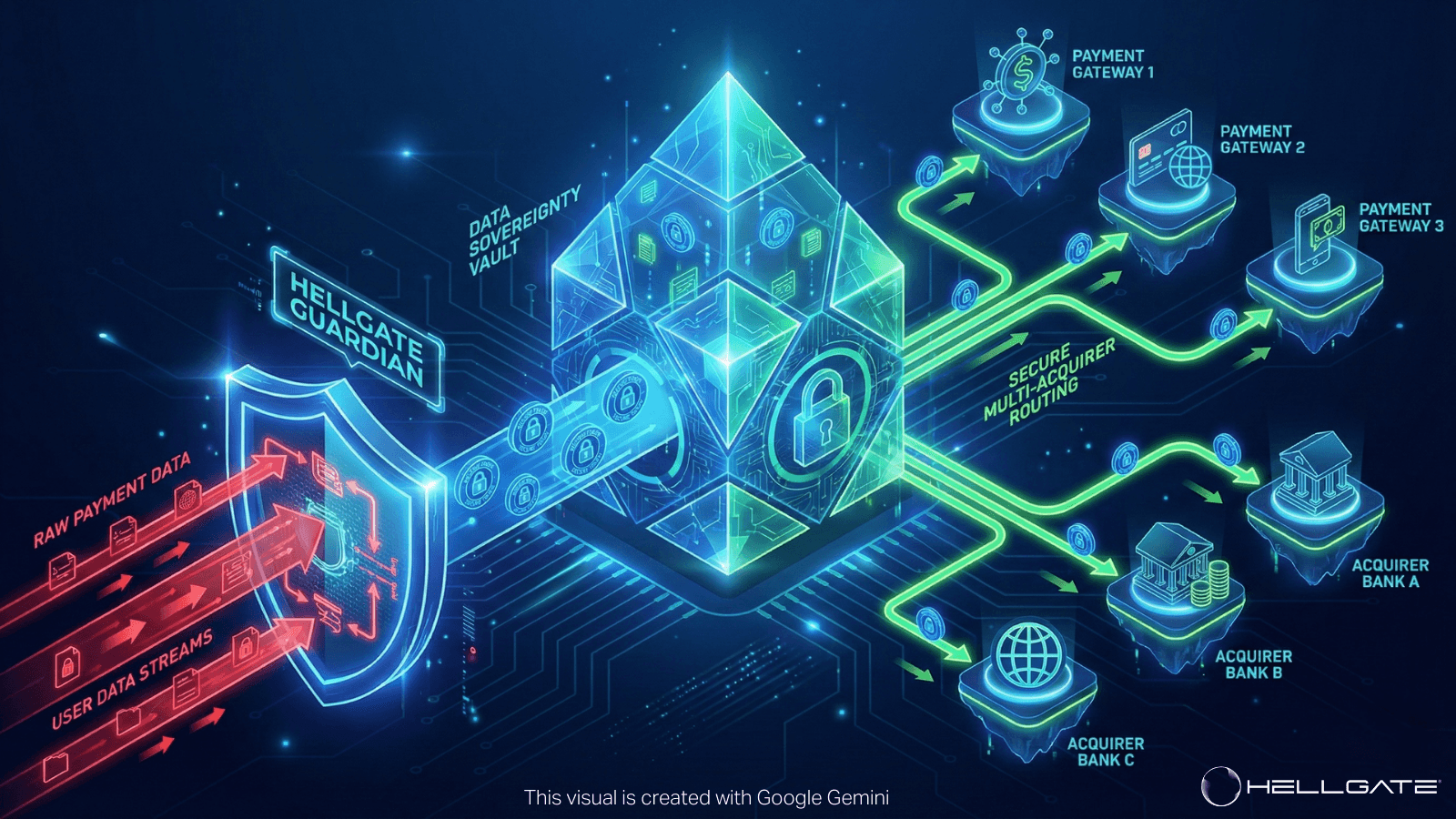
The future belongs to Composable Payment Architecture (CPA). At the heart of this shift is Hellgate Guardian-not just a vault, but a programmable, API-first tokenization engine designed to decouple data storage from transaction execution.
Here is the engineering deep dive into how Guardian delivers data sovereignty, PCI scope reduction, and revenue optimization.
1. Beyond the PAN: The Shift to Network Tokenization
The Primary Account Number (PAN) is a fossil. It is a static, 16-digit integer with no context and high liability. If a card is lost or stolen, the data dies, and your recurring revenue fails.
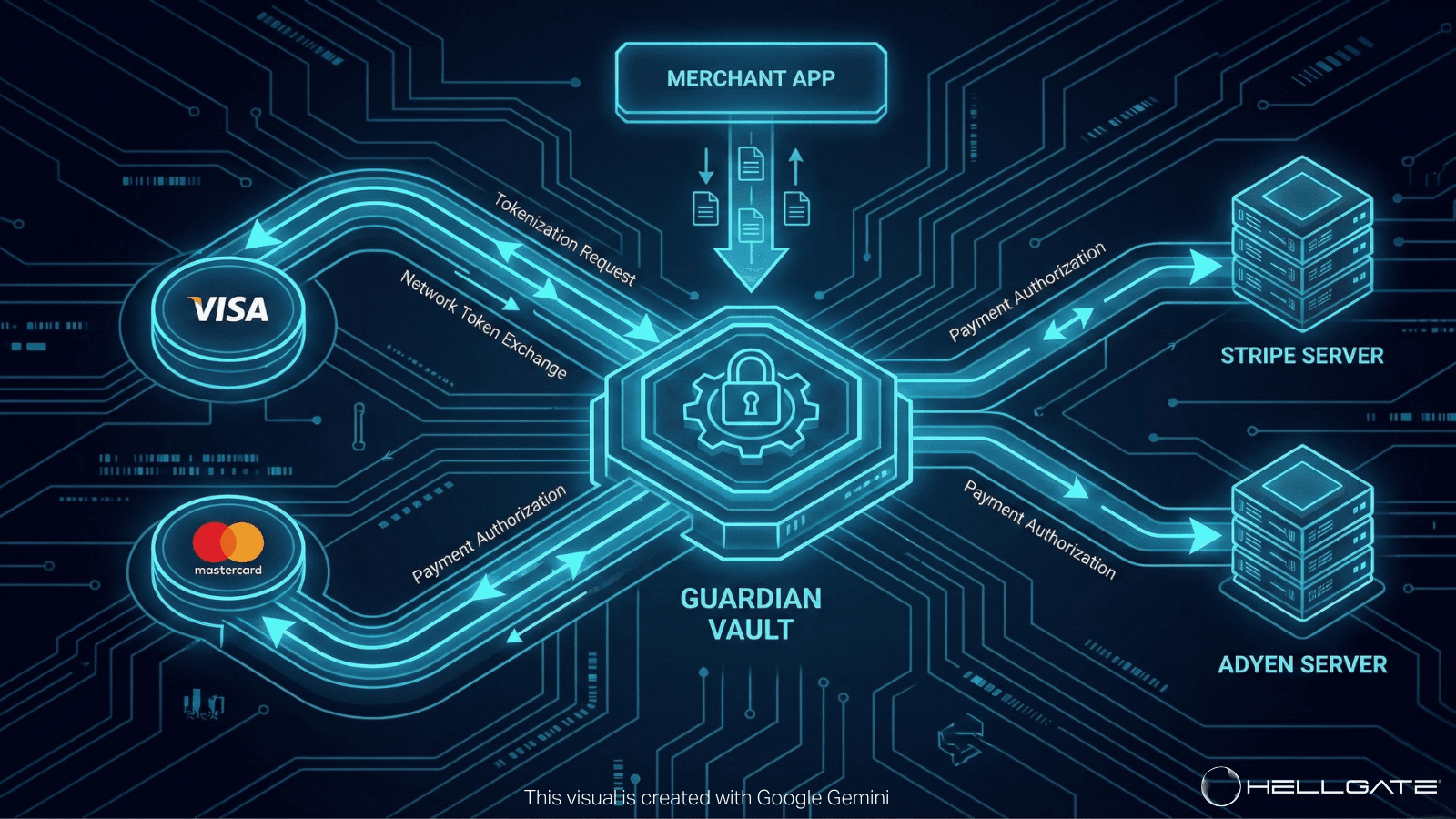
Guardian replaces this obsolete model with Network Tokenization. By integrating directly with card schemes (Visa VTS and Mastercard MDES), we replace raw PANs with dynamic, domain-bound credentials.
The "Lazy Loading" Architecture
Implementing Network Tokens often introduces latency. Guardian solves this with an asynchronous "Lazy Loading" pattern:
Capture: The user enters card details via the Guardian Web SDK. We immediately return a standard PCI Token to ensure the checkout flow completes instantly.
Async Provisioning: In the background, the Hellgate Commerce engine triggers a job to swap the PAN for a Network Token with the Scheme.
Binding: We bind the new Network Token to the customer profile without ever blocking the UI.
The ROI: Transactions processed with Network Tokens include a cryptogram that proves trust to the issuer. This results in a 2–5% uplift in Authorization Rates and significantly fewer declines for "Suspected Fraud".
2. The "Evergreen Vault": Automating Lifecycle Management
Involuntary churn-caused by expired or reissued cards-accounts for approximately 30% of all subscription revenue loss. Solving this usually requires aggressive "dunning" campaigns.
Guardian solves it with infrastructure. We call it the Evergreen Vault.
Push Updates (Network Tokens): Because Network Tokens are pointers managed by the schemes, when a physical card is reissued, the mapping updates automatically in the background. The token you hold remains valid, and the transaction succeeds with zero latency.
Poll Updates (PANs): For standard cards, Guardian’s Account Updater periodically queries the schemes to refresh expired credentials before you even attempt a charge.
The result is a payment credential that persists indefinitely, directly increasing Customer Lifetime Value (CLTV).
3. Provider Independence via Universal Tokens
The strategic core of Hellgate is Independence. Traditional PSP tokens are handcuffs; a token generated by Provider A cannot be used by Provider B.
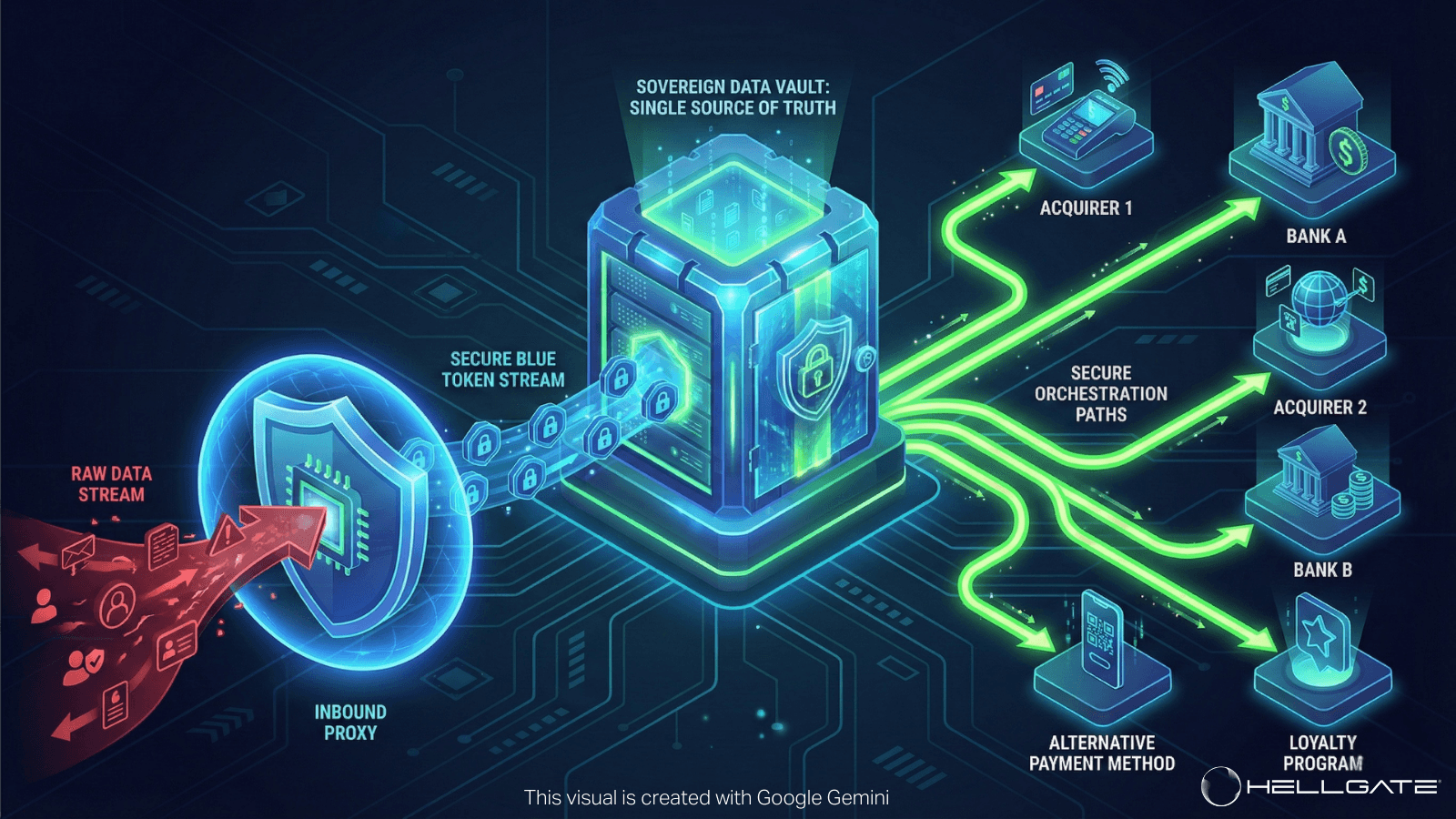
Guardian issues Universal Tokens. These are provider-agnostic identifiers that resolve to raw data stored in our sovereign vault, independent of the transaction path. This architecture is the prerequisite for Smart Routing:
Multi-Acquirer Routing: You can capture a card once and route it to Stripe for US transactions (USD) and Adyen for EU transactions (EUR).
Link Abstraction: Our Link layer receives the raw data from the vault and dynamically formats it for the specific destination API.
This allows enterprises to treat acquirers as commodities, routing volume based on Cost, Performance, or Availability. Furthermore, our CDE Import tools allow for the seamless migration of legacy data, ensuring zero downtime during vendor switches.
4. Security Architecture: The Zero-Knowledge Proxy
How do you build a sovereign stack without drowning in compliance? The answer is Isolation.
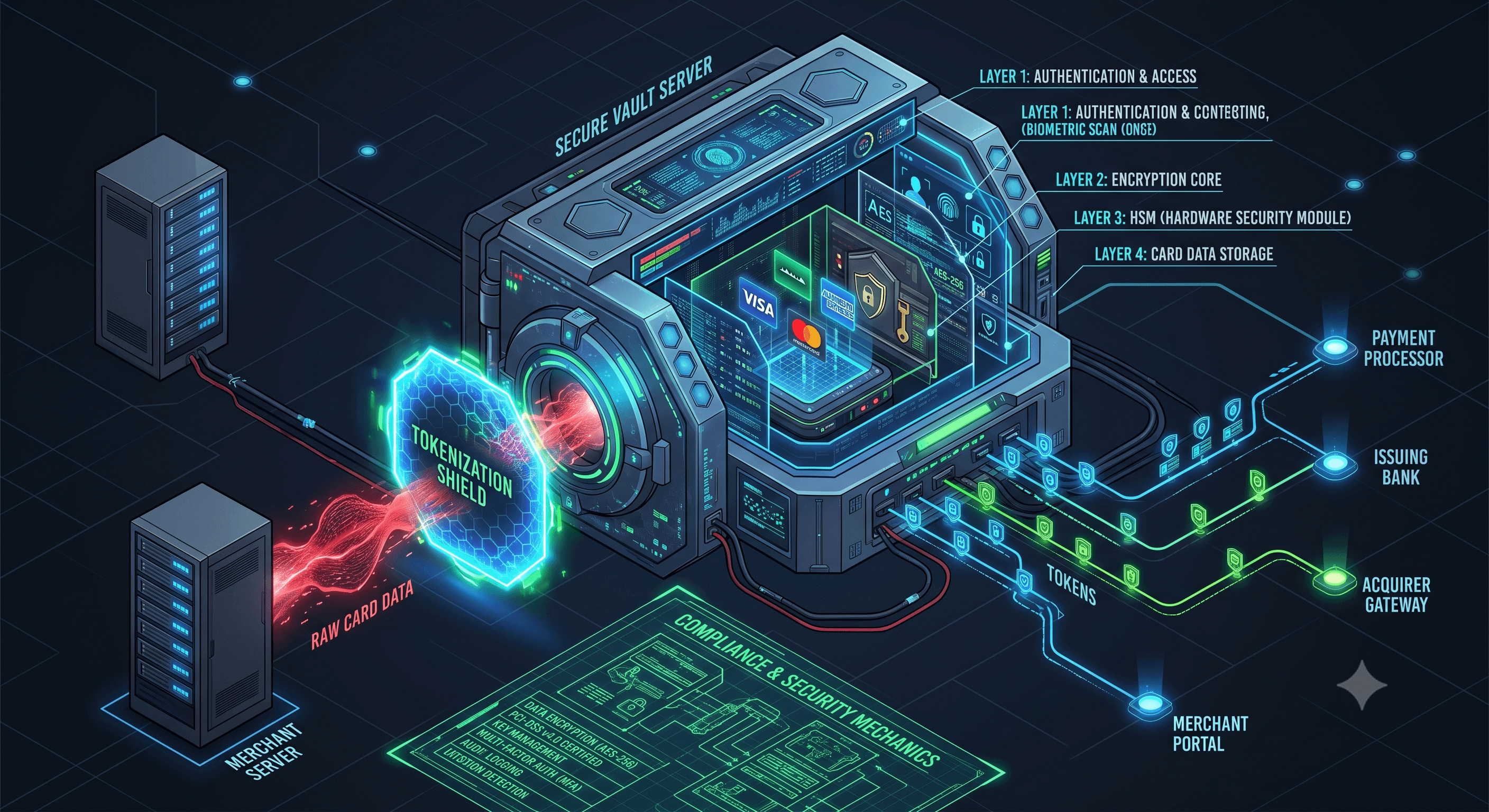
Guardian enforces a "Tokenize-First" mandate through a sophisticated Two-Way Proxy Architecture that keeps your infrastructure "Out of Scope".
Inbound Proxy (The Sanitizer): Intercepts incoming requests, extracts sensitive data (PAN/PII), vaults it, and forwards a sanitized request (with a token) to your backend. Your servers never touch the PAN.
Outbound Proxy (The Injector): Intercepts outgoing requests to third parties (like 3D Secure providers). It looks up the token and "injects" the raw data into the payload milliseconds before transmission.
Compliance Impact: Because your systems never store, process, or transmit raw card data, you qualify for SAQ A-reducing your compliance burden from hundreds of controls (SAQ D) to a simple checklist.
5. Beyond Payments: PII and Generic Tokens
Modern enterprises handle more than just credit cards. They manage IBANs, Tax IDs, and Passport Numbers for KYC. Storing this Personally Identifiable Information (PII) creates massive GDPR and data breach liability.
Guardian extends its vaulting capabilities with Generic Tokens governed by strict JSON Schemas.
Marketplace KYC: Vault sensitive seller documents (e.g., Passports) and only expose them to identity verification providers via the Outbound Proxy.
Agentic Commerce: Issue restricted tokens to AI agents. An autonomous agent can negotiate and "pay" using a token, while the Guardian infrastructure ensures the underlying credential is never exposed to the bot itself.
Conclusion
The detailed analysis of Hellgate Guardian reveals a system that transcends the traditional "Token Vault." By combining Network Tokenization, Automated Lifecycle Management, and Proxy Architecture, Guardian provides the security, sovereignty, and interoperability required for the next generation of digital commerce.
Don't let your infrastructure define your strategy. Let your strategy define your infrastructure.
The Mechanics of Composable Tokenization: Architecting a Sovereign Payment Stack
The era of the "Black Box" Payment Service Provider (PSP) is ending. For the last decade, enterprise merchants have accepted a dangerous trade-off: convenience in exchange for control. By locking their data into proprietary vaults (the "Walled Garden" model), they surrendered their leverage, accepted static authorization rates, and buried their engineering teams in compliance overhead.
The future belongs to Composable Payment Architecture (CPA). At the heart of this shift is Hellgate Guardian-not just a vault, but a programmable, API-first tokenization engine designed to decouple data storage from transaction execution.
Here is the engineering deep dive into how Guardian delivers data sovereignty, PCI scope reduction, and revenue optimization.
1. Beyond the PAN: The Shift to Network Tokenization
The Primary Account Number (PAN) is a fossil. It is a static, 16-digit integer with no context and high liability. If a card is lost or stolen, the data dies, and your recurring revenue fails.
Guardian replaces this obsolete model with Network Tokenization. By integrating directly with card schemes (Visa VTS and Mastercard MDES), we replace raw PANs with dynamic, domain-bound credentials.
The "Lazy Loading" Architecture
Implementing Network Tokens often introduces latency. Guardian solves this with an asynchronous "Lazy Loading" pattern:
Capture: The user enters card details via the Guardian Web SDK. We immediately return a standard PCI Token to ensure the checkout flow completes instantly.
Async Provisioning: In the background, the Hellgate Commerce engine triggers a job to swap the PAN for a Network Token with the Scheme.
Binding: We bind the new Network Token to the customer profile without ever blocking the UI.
The ROI: Transactions processed with Network Tokens include a cryptogram that proves trust to the issuer. This results in a 2–5% uplift in Authorization Rates and significantly fewer declines for "Suspected Fraud".
2. The "Evergreen Vault": Automating Lifecycle Management
Involuntary churn-caused by expired or reissued cards-accounts for approximately 30% of all subscription revenue loss. Solving this usually requires aggressive "dunning" campaigns.
Guardian solves it with infrastructure. We call it the Evergreen Vault.
Push Updates (Network Tokens): Because Network Tokens are pointers managed by the schemes, when a physical card is reissued, the mapping updates automatically in the background. The token you hold remains valid, and the transaction succeeds with zero latency.
Poll Updates (PANs): For standard cards, Guardian’s Account Updater periodically queries the schemes to refresh expired credentials before you even attempt a charge.
The result is a payment credential that persists indefinitely, directly increasing Customer Lifetime Value (CLTV).
3. Provider Independence via Universal Tokens
The strategic core of Hellgate is Independence. Traditional PSP tokens are handcuffs; a token generated by Provider A cannot be used by Provider B.
Guardian issues Universal Tokens. These are provider-agnostic identifiers that resolve to raw data stored in our sovereign vault, independent of the transaction path. This architecture is the prerequisite for Smart Routing:
Multi-Acquirer Routing: You can capture a card once and route it to Stripe for US transactions (USD) and Adyen for EU transactions (EUR).
Link Abstraction: Our Link layer receives the raw data from the vault and dynamically formats it for the specific destination API.
This allows enterprises to treat acquirers as commodities, routing volume based on Cost, Performance, or Availability. Furthermore, our CDE Import tools allow for the seamless migration of legacy data, ensuring zero downtime during vendor switches.
4. Security Architecture: The Zero-Knowledge Proxy
How do you build a sovereign stack without drowning in compliance? The answer is Isolation.
Guardian enforces a "Tokenize-First" mandate through a sophisticated Two-Way Proxy Architecture that keeps your infrastructure "Out of Scope".
Inbound Proxy (The Sanitizer): Intercepts incoming requests, extracts sensitive data (PAN/PII), vaults it, and forwards a sanitized request (with a token) to your backend. Your servers never touch the PAN.
Outbound Proxy (The Injector): Intercepts outgoing requests to third parties (like 3D Secure providers). It looks up the token and "injects" the raw data into the payload milliseconds before transmission.
Compliance Impact: Because your systems never store, process, or transmit raw card data, you qualify for SAQ A-reducing your compliance burden from hundreds of controls (SAQ D) to a simple checklist.
5. Beyond Payments: PII and Generic Tokens
Modern enterprises handle more than just credit cards. They manage IBANs, Tax IDs, and Passport Numbers for KYC. Storing this Personally Identifiable Information (PII) creates massive GDPR and data breach liability.
Guardian extends its vaulting capabilities with Generic Tokens governed by strict JSON Schemas.
Marketplace KYC: Vault sensitive seller documents (e.g., Passports) and only expose them to identity verification providers via the Outbound Proxy.
Agentic Commerce: Issue restricted tokens to AI agents. An autonomous agent can negotiate and "pay" using a token, while the Guardian infrastructure ensures the underlying credential is never exposed to the bot itself.
Conclusion
The detailed analysis of Hellgate Guardian reveals a system that transcends the traditional "Token Vault." By combining Network Tokenization, Automated Lifecycle Management, and Proxy Architecture, Guardian provides the security, sovereignty, and interoperability required for the next generation of digital commerce.
Don't let your infrastructure define your strategy. Let your strategy define your infrastructure.
The Mechanics of Composable Tokenization: Architecting a Sovereign Payment Stack
The era of the "Black Box" Payment Service Provider (PSP) is ending. For the last decade, enterprise merchants have accepted a dangerous trade-off: convenience in exchange for control. By locking their data into proprietary vaults (the "Walled Garden" model), they surrendered their leverage, accepted static authorization rates, and buried their engineering teams in compliance overhead.
The future belongs to Composable Payment Architecture (CPA). At the heart of this shift is Hellgate Guardian-not just a vault, but a programmable, API-first tokenization engine designed to decouple data storage from transaction execution.
Here is the engineering deep dive into how Guardian delivers data sovereignty, PCI scope reduction, and revenue optimization.
1. Beyond the PAN: The Shift to Network Tokenization
The Primary Account Number (PAN) is a fossil. It is a static, 16-digit integer with no context and high liability. If a card is lost or stolen, the data dies, and your recurring revenue fails.
Guardian replaces this obsolete model with Network Tokenization. By integrating directly with card schemes (Visa VTS and Mastercard MDES), we replace raw PANs with dynamic, domain-bound credentials.
The "Lazy Loading" Architecture
Implementing Network Tokens often introduces latency. Guardian solves this with an asynchronous "Lazy Loading" pattern:
Capture: The user enters card details via the Guardian Web SDK. We immediately return a standard PCI Token to ensure the checkout flow completes instantly.
Async Provisioning: In the background, the Hellgate Commerce engine triggers a job to swap the PAN for a Network Token with the Scheme.
Binding: We bind the new Network Token to the customer profile without ever blocking the UI.
The ROI: Transactions processed with Network Tokens include a cryptogram that proves trust to the issuer. This results in a 2–5% uplift in Authorization Rates and significantly fewer declines for "Suspected Fraud".
2. The "Evergreen Vault": Automating Lifecycle Management
Involuntary churn-caused by expired or reissued cards-accounts for approximately 30% of all subscription revenue loss. Solving this usually requires aggressive "dunning" campaigns.
Guardian solves it with infrastructure. We call it the Evergreen Vault.
Push Updates (Network Tokens): Because Network Tokens are pointers managed by the schemes, when a physical card is reissued, the mapping updates automatically in the background. The token you hold remains valid, and the transaction succeeds with zero latency.
Poll Updates (PANs): For standard cards, Guardian’s Account Updater periodically queries the schemes to refresh expired credentials before you even attempt a charge.
The result is a payment credential that persists indefinitely, directly increasing Customer Lifetime Value (CLTV).
3. Provider Independence via Universal Tokens
The strategic core of Hellgate is Independence. Traditional PSP tokens are handcuffs; a token generated by Provider A cannot be used by Provider B.
Guardian issues Universal Tokens. These are provider-agnostic identifiers that resolve to raw data stored in our sovereign vault, independent of the transaction path. This architecture is the prerequisite for Smart Routing:
Multi-Acquirer Routing: You can capture a card once and route it to Stripe for US transactions (USD) and Adyen for EU transactions (EUR).
Link Abstraction: Our Link layer receives the raw data from the vault and dynamically formats it for the specific destination API.
This allows enterprises to treat acquirers as commodities, routing volume based on Cost, Performance, or Availability. Furthermore, our CDE Import tools allow for the seamless migration of legacy data, ensuring zero downtime during vendor switches.
4. Security Architecture: The Zero-Knowledge Proxy
How do you build a sovereign stack without drowning in compliance? The answer is Isolation.
Guardian enforces a "Tokenize-First" mandate through a sophisticated Two-Way Proxy Architecture that keeps your infrastructure "Out of Scope".
Inbound Proxy (The Sanitizer): Intercepts incoming requests, extracts sensitive data (PAN/PII), vaults it, and forwards a sanitized request (with a token) to your backend. Your servers never touch the PAN.
Outbound Proxy (The Injector): Intercepts outgoing requests to third parties (like 3D Secure providers). It looks up the token and "injects" the raw data into the payload milliseconds before transmission.
Compliance Impact: Because your systems never store, process, or transmit raw card data, you qualify for SAQ A-reducing your compliance burden from hundreds of controls (SAQ D) to a simple checklist.
5. Beyond Payments: PII and Generic Tokens
Modern enterprises handle more than just credit cards. They manage IBANs, Tax IDs, and Passport Numbers for KYC. Storing this Personally Identifiable Information (PII) creates massive GDPR and data breach liability.
Guardian extends its vaulting capabilities with Generic Tokens governed by strict JSON Schemas.
Marketplace KYC: Vault sensitive seller documents (e.g., Passports) and only expose them to identity verification providers via the Outbound Proxy.
Agentic Commerce: Issue restricted tokens to AI agents. An autonomous agent can negotiate and "pay" using a token, while the Guardian infrastructure ensures the underlying credential is never exposed to the bot itself.
Conclusion
The detailed analysis of Hellgate Guardian reveals a system that transcends the traditional "Token Vault." By combining Network Tokenization, Automated Lifecycle Management, and Proxy Architecture, Guardian provides the security, sovereignty, and interoperability required for the next generation of digital commerce.
Don't let your infrastructure define your strategy. Let your strategy define your infrastructure.
Co-Founder & Chief of Revenue and growth at Starfish & Co. – creators of Hellgate®
Jens Kohnen was driven to co-start the company by the conviction that payment infrastructure should empower businesses, not bind them. Recognizing that many large organizations were locked into monolithic, opaque setups, Jens embarked on a journey to free enterprises from these rigid stacks. His mission is to enable companies to regain full ownership and monetize their flows, transforming payments from a cost center into a strategic lever for growth.
Vaulting
Jan 15, 2026
Tokenization as a Service: The Infrastructure-First Approach to Data Security

Vaulting
Jan 15, 2026
Tokenization as a Service: The Infrastructure-First Approach to Data Security

Vaulting
Jan 15, 2026
Tokenization as a Service: The Infrastructure-First Approach to Data Security

Vaulting
Jan 9, 2026
Beyond the PSP: Choosing the Right Payment Tokenization Service Provider

Vaulting
Jan 9, 2026
Beyond the PSP: Choosing the Right Payment Tokenization Service Provider

Vaulting
Jan 9, 2026
Beyond the PSP: Choosing the Right Payment Tokenization Service Provider

Vaulting
Jan 5, 2026
Network Tokens vs PCI Tokens: The Complete Enterprise Decision Framework

Vaulting
Jan 5, 2026
Network Tokens vs PCI Tokens: The Complete Enterprise Decision Framework

Vaulting
Jan 5, 2026
Network Tokens vs PCI Tokens: The Complete Enterprise Decision Framework
See Hellgate CPA in action
Let our product specialists guide you through the platform, touch upon all functionalities relevant for your individual use case and answer all your questions directly.
See Hellgate CPA in action
Let our product specialists guide you through the platform, touch upon all functionalities relevant for your individual use case and answer all your questions directly.
See Hellgate CPA in action
Let our product specialists guide you through the platform, touch upon all functionalities relevant for your individual use case and answer all your questions directly.