
Vaulting
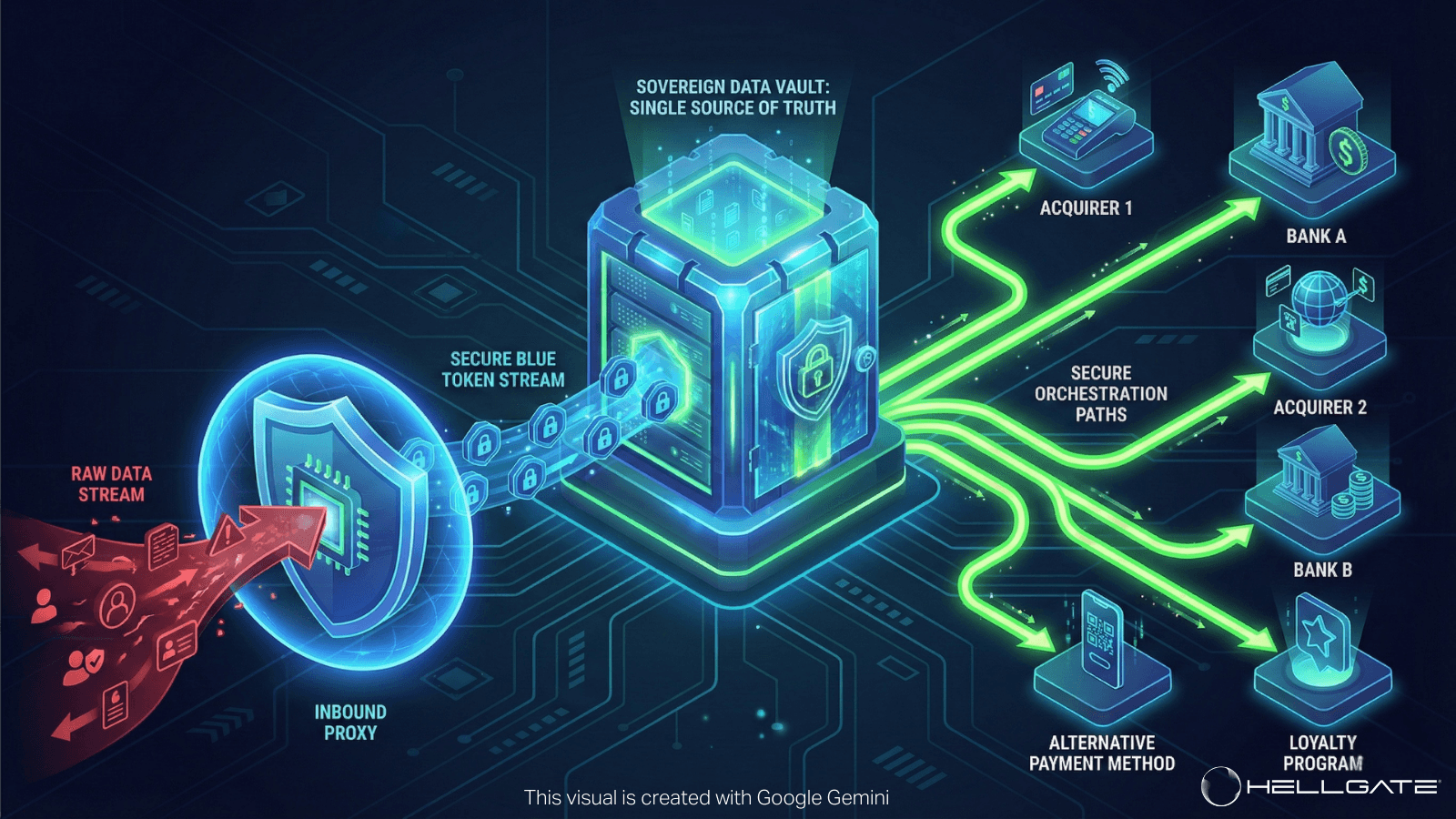
The ROI of Sovereignty: Future-Proofing Enterprise Payments Beyond the PSP
The era of the monolithic Payment Service Provider (PSP) is ending. When enterprises rely exclusively on a closed provider ecosystem, they surrender data portability and inflate their compliance budgets. True operational agility requires decoupling your card data vault from your payment processors.
Hellgate Guardian utilizes cloud-native tokenization to resolve these critical bottlenecks. By giving you absolute control over your cardholder data environment (CDE), Guardian transforms your payment stack from a rigid liability into an engine of quantifiable ROI.
Here is how modern enterprises are deploying Guardian to optimize revenue, mitigate risk, and prepare for the next generation of commerce.
1. Eradicating Involuntary Churn with Network Tokenization
Involuntary churn is not a customer success problem; it is an infrastructure failure. Industry data reveals that failed payments due to expired, lost, or reissued cards affect 10-15% of recurring transactions annually. Static PCI tokens decay, leaking massive amounts of revenue.
Guardian bypasses the PSP to provision network tokens directly via the Visa Token Service (VTS) and the Mastercard Digital Enablement Service (MDES). Paired with automated life-cycle management tools like the Visa Account Updater (VAU), these dynamic scheme tokens refresh in the background without user intervention. The financial result is eradicated involuntary churn and immediate authorization rate optimization.
2. The Economics of Data Isolation and SAQ D Avoidance
Storing the Primary Account Number (PAN) on your own servers is a massive financial and operational liability. Under PCI DSS v4.0, drifting into a rigorous SAQ D audit can cost an enterprise between $245,000 and $600,000 annually in internal labor, technology improvements, and QSA assessments.
Guardian’s proxy architecture intercepts the PAN data and vaults it before it ever reaches your internal servers. You retain 100% programmatic control over your checkout flow, but your backend remains technically blind to the toxic data. This zero-knowledge architecture delivers massive PCI scope reduction, returning your enterprise to the highly cost-effective SAQ (Self-Assessment Questionnaire) A compliance tier.
3. Unifying PCI-DSS and GDPR Compliance
Your payment stack shouldn't be the only layer that gets enterprise-grade credential management. Personally Identifiable Information (PII), SEPA mandates, and API secrets carry massive GDPR liabilities if breached.
Guardian extends beyond payments by utilizing Generic Tokens to securely store non-card data and arbitrary, JSON-serializable payloads. Strict schema validation ("Types") allows you to shape, filter, and validate API keys and secrets securely. Guardian serves as a unified, high availability roof for all your enterprise secrets, consolidating your compliance architecture into one sovereign vault with a clear audit trail.
4. Infrastructure for Agentic Commerce
The next era of commerce is machine-to-machine. AI agents are already beginning to negotiate and execute transactions autonomously, but legacy payment gateways are fundamentally incompatible with this shift.
Agentic commerce requires headless, API-first infrastructure. Guardian acts as the "Wallet for AI," utilizing dynamic storable credentials that empower agents to transact safely and transparently. The raw financial data is never exposed to the agent, establishing Guardian as the cryptographic trust anchor for the autonomous economy.
5. The Ultimate Vendor Leverage
The ultimate metric of a mature payment stack is your negotiating leverage. If a PSP goes down on Black Friday and your gateway tokens are useless elsewhere, you do not own your infrastructure.
By decoupling the vault from the processor, you own the universal token and regain complete data portability. Guardian issues tokens designed for true multi-acquirer tokenization, allowing you to route transactions dynamically to the most cost-effective acquirers, failover instantly, and negotiate fees from a position of absolute power.
Stop building in walled gardens. Reclaim your PCI compliance and assemble a resilient, independent payment stack today.
Jens Kohnen was driven to co-start the company by the conviction that payment infrastructure should empower businesses, not bind them. Recognizing that many large organizations were locked into monolithic, opaque setups, Jens embarked on a journey to free enterprises from these rigid stacks. His mission is to enable companies to regain full ownership and monetize their flows, transforming payments from a cost center into a strategic lever for growth.
Vaulting
Jun 11, 2026
Credit Card Vault: What It Is, How It Works, and Why Enterprises Need One
Vaulting
Feb 23, 2026
Decoupling the Payment Stack: How Enterprises Are Reclaiming Data Sovereignty and Revenue
Vaulting
Feb 16, 2026