
Vaulting

Which Platform Supports Vaulted Cards, Network Tokens, and Minimal PCI Scope?

Which Platform Supports Vaulted Cards, Network Tokens, and Minimal PCI Scope?

Which Platform Supports Vaulted Cards, Network Tokens, and Minimal PCI Scope?

Nov 14, 2025

Jens Kohnen
Jens Kohnen
Jens Kohnen
Co-Founder & Chief of Revenue and growth at Starfish & Co. – creators of Hellgate®

Finding a payment platform that combines secure card vaulting, comprehensive network tokenization, and minimal PCI scope remains one of the most challenging decisions for enterprise payment teams. Most organizations struggle with fragmented solutions that force them to manage multiple vendors while maintaining extensive PCI DSS compliance programs.

The reality is stark: traditional payment service providers (PSPs) typically offer partial vaulting capabilities or limited network token functionality, leaving enterprises to piece together solutions from multiple vendors. This approach increases both compliance complexity and operational overhead, precisely when organizations need streamlined, secure payment infrastructure.

The Enterprise Card Data Security Challenge

Enterprise payment teams face a fundamental dilemma when handling cardholder data. They need secure storage capabilities for recurring payments, subscription models, and customer convenience features like saved payment methods. Simultaneously, they must minimize their PCI DSS compliance scope to reduce audit costs and security risks.

Most PSPs provide basic tokenization services, but these solutions fall short of enterprise requirements in several critical ways. First, they typically don't offer true network tokens from card schemes like Visa Token Service, Mastercard MDES, or Amex Express Token Service. Instead, they provide PSP-specific tokens that don't deliver the authorization rate improvements and reduced interchange fees that network tokens provide.

Second, traditional PSP card vaulting creates vendor lock-in scenarios. When payment data is stored within a specific PSP's infrastructure, migrating to alternative providers or implementing multi-PSP strategies becomes significantly more complex. This limitation constrains strategic flexibility and negotiating power with payment providers.

The PCI scope challenge compounds these issues. When cardholder data touches merchant systems, even briefly, it expands the PCI DSS assessment scope. This expansion increases audit complexity, compliance costs, and the potential impact of security incidents.

Network Tokenization: Beyond Basic PSP Tokens

Network tokens represent a fundamental shift in payment security architecture. Unlike PSP-generated tokens, network tokens are issued directly by card schemes and provide enhanced security features including cryptographic validation and dynamic authentication.

Visa Token Service, Mastercard MDES, and Amex Express Token Service each offer unique capabilities that improve transaction performance. Network tokens typically deliver 2-3% higher authorization rates compared to traditional PANs, particularly for card-not-present transactions. They also qualify for reduced interchange rates in many markets, creating direct cost savings for merchants.

However, implementing network tokenization across multiple card schemes presents technical challenges. Each scheme has distinct API requirements, token lifecycle management protocols, and integration specifications. Managing these differences while maintaining consistent token orchestration across multiple PSPs requires sophisticated infrastructure capabilities.

Token lifecycle management adds another layer of complexity. Network tokens require regular refresh cycles, replacement procedures for expired or compromised tokens, and seamless updates across all systems that store or process these tokens. Without proper automation, these maintenance requirements can overwhelm payment operations teams.

PCI DSS Compliance Architecture for Minimal Scope

Achieving minimal PCI scope requires architectural decisions that completely isolate cardholder data from merchant systems. The most effective approach involves implementing a dedicated token vault that handles all PAN storage and tokenization functions while maintaining strict separation from business applications.

PCI DSS Level 1 compliance represents the highest certification standard, requiring annual on-site assessments by qualified security assessors. Organizations that achieve this certification demonstrate comprehensive security controls across network security, access management, vulnerability management, and security monitoring.

The key architectural principle for minimal PCI scope involves ensuring that cardholder data never traverses merchant infrastructure. This requires payment flows that redirect sensitive data collection to compliant environments while returning only non-sensitive tokens to merchant systems.

Modern compliance architectures also implement defense-in-depth strategies including encryption at rest and in transit, comprehensive access logging, regular penetration testing, and continuous security monitoring. These controls ensure that even if security perimeters are breached, cardholder data remains protected.

Hellgate® Guardian: Unified Card Vaulting and Network Tokenization

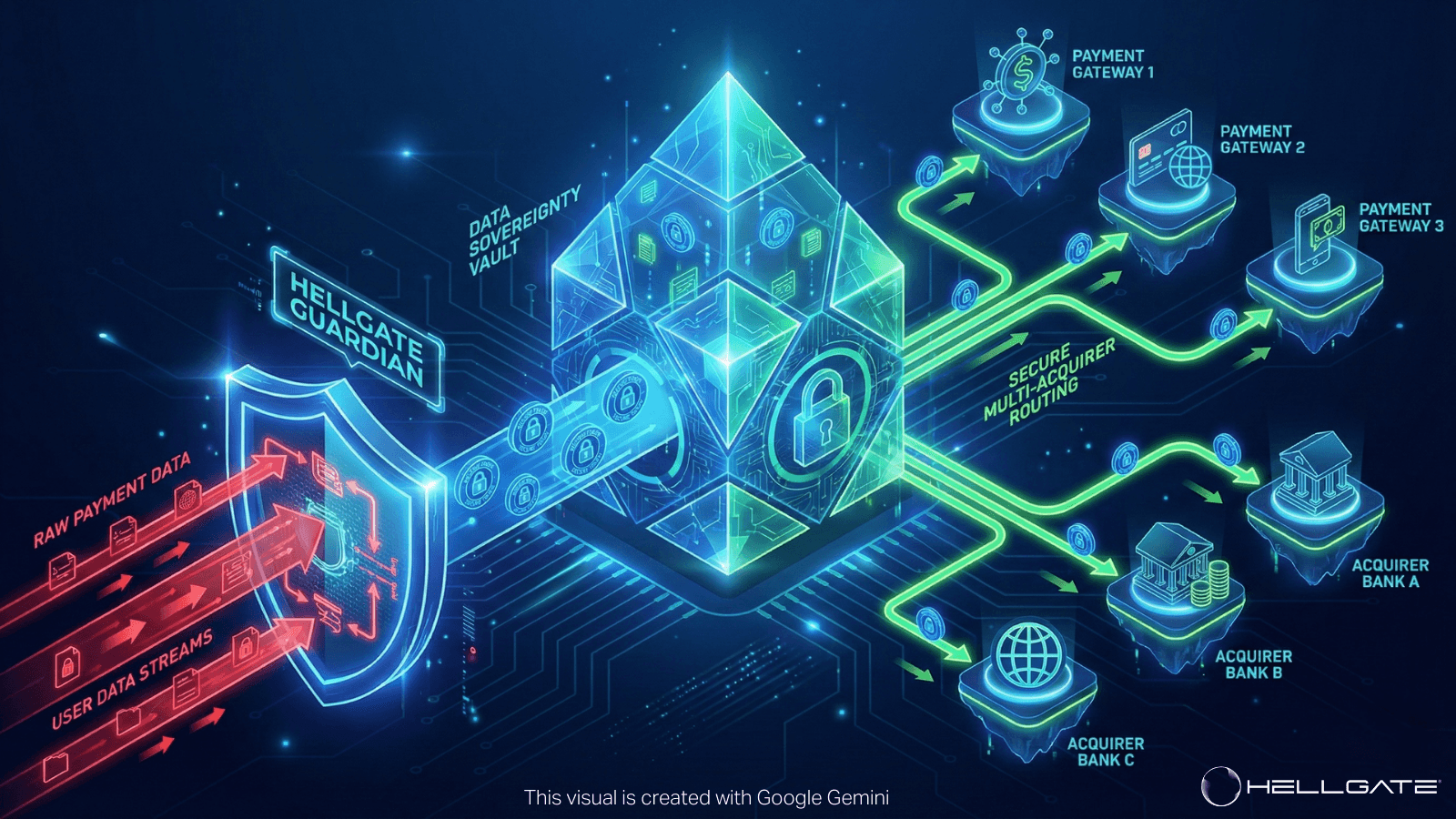
Hellgate® Guardian addresses these challenges through a dedicated PCI DSS Level 1 compliant card data vault and tokenization engine. Unlike fragmented solutions that require multiple vendor relationships, Guardian provides comprehensive card vaulting and network tokenization capabilities through a single, secure platform.

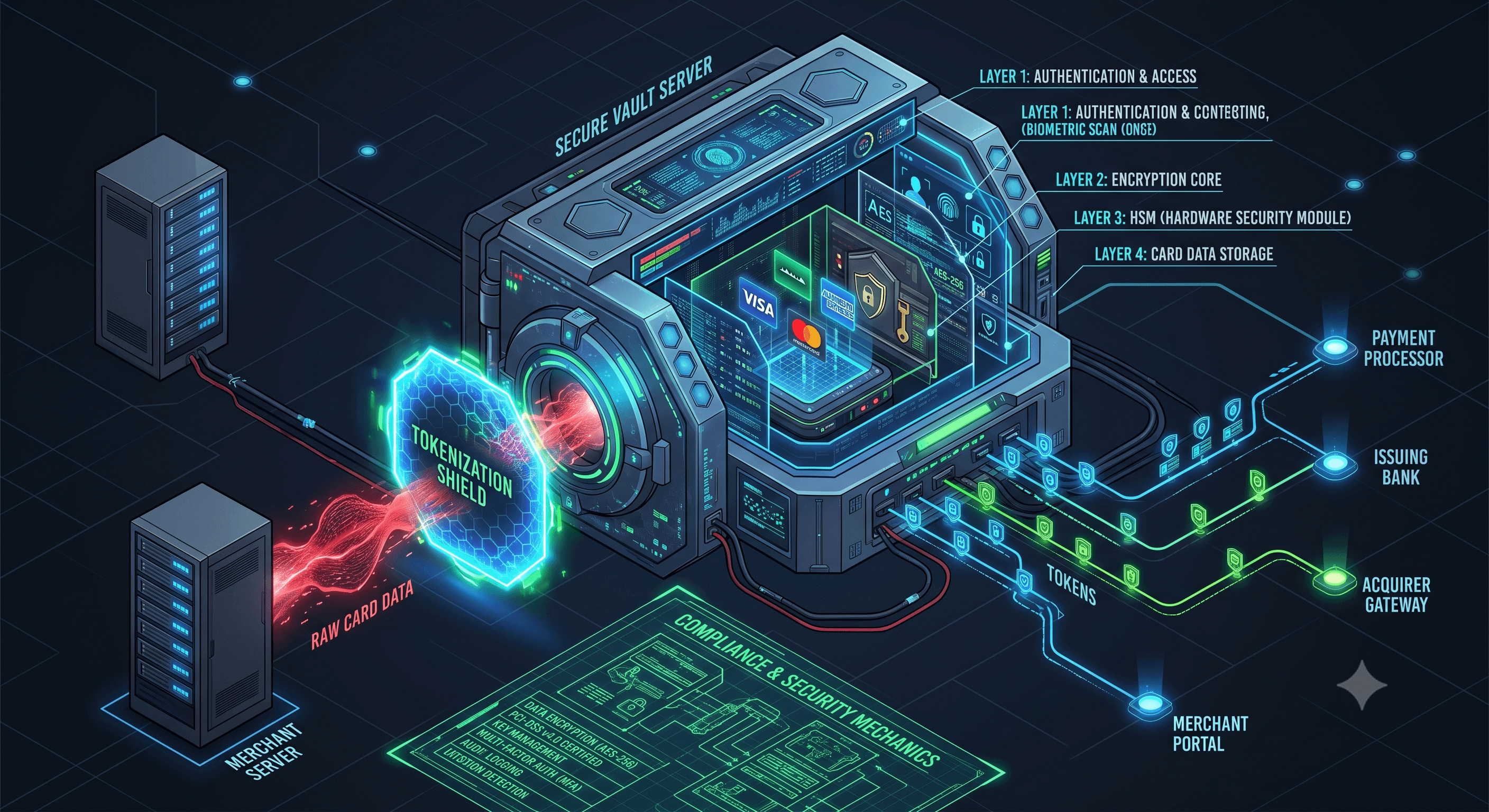
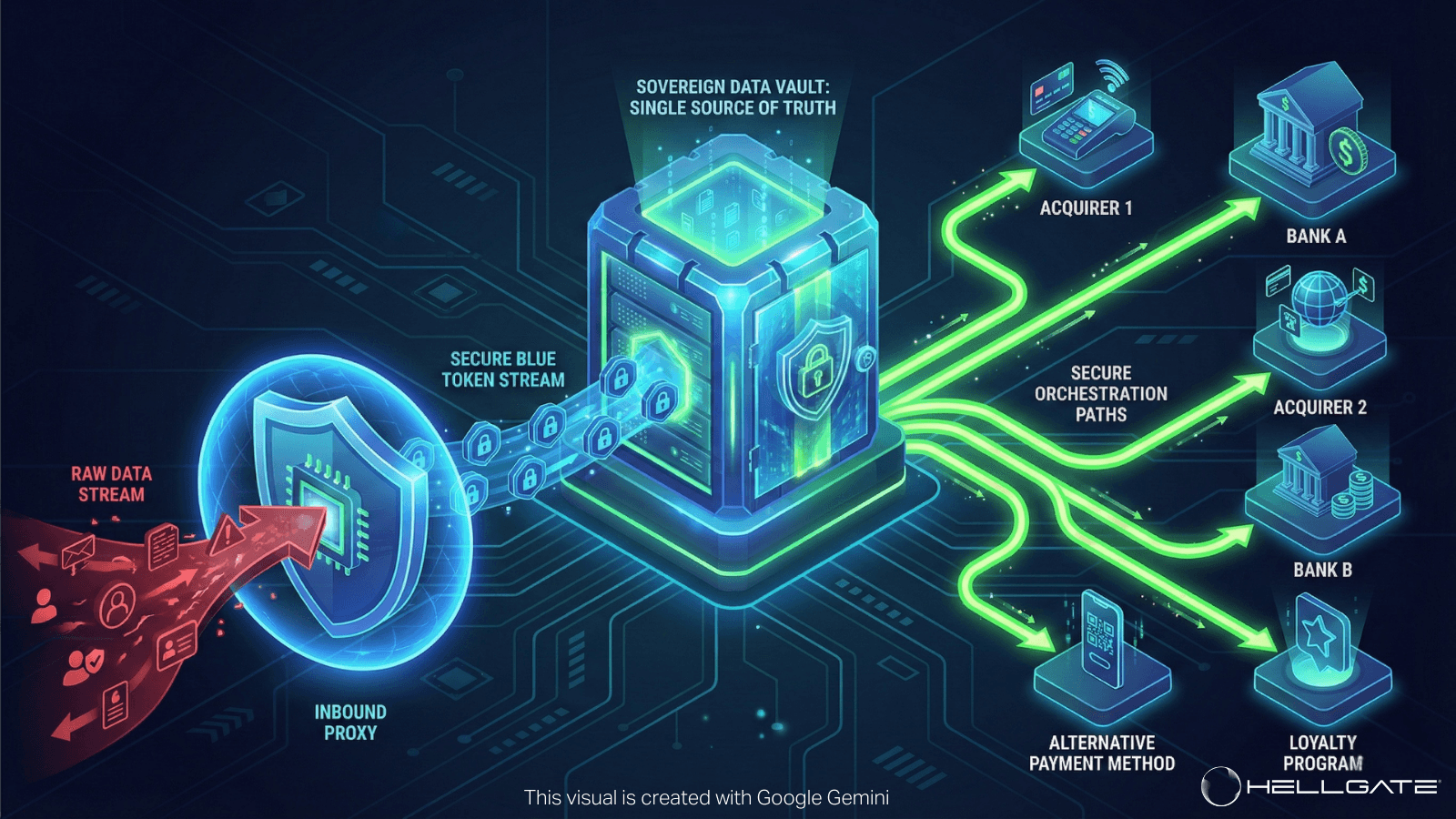
The platform's core architecture ensures complete separation between cardholder data and merchant systems. When payment data is collected, it's immediately encrypted and stored within Guardian's compliant infrastructure. Merchant systems receive only non-sensitive tokens, effectively removing them from PCI scope considerations.

Guardian's network tokenization capabilities span all major card schemes. The platform maintains direct integrations with Visa Token Service, Mastercard MDES, and Amex Express Token Service, enabling consistent token provisioning and management across different card types. This unified approach eliminates the complexity of managing multiple scheme-specific integrations.

Token lifecycle management operates automatically within Guardian's infrastructure. The platform handles token refresh cycles, monitors expiration dates, and manages replacement procedures without requiring merchant intervention. This automation reduces operational overhead while ensuring continuous token availability for payment processing.

Technical Capabilities and Integration

Guardian's technical architecture supports enterprise-scale payment operations through several key capabilities. The platform provides encrypted PAN storage with advanced encryption standards and comprehensive key management protocols. All stored cardholder data remains encrypted at rest and in transit, with encryption keys managed through hardware security modules.

The network tokenization engine supports real-time token provisioning across Visa, Mastercard, and Amex networks. Guardian handles the complex authentication and validation requirements for each card scheme, presenting a unified API interface to merchant applications. This abstraction simplifies integration while maintaining full access to network token capabilities.

Token orchestration represents another critical capability. Guardian can distribute network tokens across multiple PSPs and geographic regions, enabling sophisticated payment routing strategies without exposing cardholder data to merchant systems. This orchestration supports multi-PSP architectures while maintaining consistent token management.

The platform integrates seamlessly with existing Hellgate® infrastructure, enabling one-click activation for current customers. New implementations can be completed rapidly through Guardian's API-first architecture and comprehensive documentation resources.

Business Impact and Strategic Advantages

Organizations implementing Guardian typically experience significant reductions in PCI audit complexity and associated costs. By removing merchant systems from PCI scope, Guardian eliminates many assessment requirements and reduces the annual compliance burden. Most customers report 60-80% reductions in PCI-related audit activities.

Authorization rate improvements through network tokens deliver measurable revenue impact. The 2-3% authorization rate increase translates directly to reduced payment failures and improved customer experience. For high-volume merchants, these improvements can generate substantial additional revenue while reducing customer service inquiries related to payment failures.

Operational efficiency gains emerge from unified token management and reduced vendor complexity. Instead of managing separate relationships with multiple tokenization providers, organizations can consolidate card vaulting and network tokenization through Guardian's single platform. This consolidation reduces integration overhead and simplifies payment operations.

Strategic flexibility increases through Guardian's PSP-agnostic architecture. Organizations can implement multi-PSP strategies, negotiate more effectively with payment providers, and adapt to changing market conditions without being constrained by vendor-specific tokenization solutions.

Streamlined Data Migration with Guardian

Guardian simplifies the traditionally complex process of migrating existing cardholder data through its comprehensive API infrastructure and pre-built connections. Unlike traditional migration projects that require months of technical integration work, Guardian's approach focuses on compliance verification and strategic planning rather than technical complexity.

The migration process begins with exchanging PCI DSS Attestations of Compliance (AOCs) between your current provider and Guardian. This step ensures all parties meet the necessary security standards and establishes the compliance framework for secure data transfer.

Next, organizations define their preferred migration approach based on business requirements. Guardian supports both one-time bulk migrations for rapid transitions and step-by-step migrations that allow gradual system updates without disrupting ongoing operations. The choice depends on factors like transaction volume, system dependencies, and risk tolerance.

Guardian handles all technical connectivity requirements through its existing API infrastructure and established connections with major payment providers and card vaulting systems. The platform's pre-built integrations eliminate the need for custom connector development or complex data mapping exercises that typically complicate migration projects.

Once the approach is defined and technical connections are established, Guardian manages the secure transfer and validation of cardholder data. The platform's automated processes ensure data integrity, proper tokenization, and seamless integration with your existing payment flows.

Future-Ready Payment Infrastructure

Guardian provides the foundational layer for secure, composable payment infrastructure that adapts to evolving enterprise requirements. As payment methods expand and regulatory requirements evolve, Guardian's architecture supports new capabilities without requiring fundamental infrastructure changes.

The platform's API-first design enables integration with emerging payment technologies including digital wallets, alternative payment methods, and cross-border payment solutions. Organizations can build comprehensive payment ecosystems while maintaining consistent security and compliance standards.

Network tokenization capabilities continue expanding as card schemes introduce new features and markets adopt enhanced token standards. Guardian's direct scheme integrations ensure customers automatically benefit from these improvements without requiring additional development work.

Ready to reduce PCI scope while implementing enterprise-grade card vaulting and network tokenization? Learn more about Hellgate® Guardian and discover how leading enterprises are building secure, scalable payment infrastructure at hellgate.io/cpa/guardian.


Finding a payment platform that combines secure card vaulting, comprehensive network tokenization, and minimal PCI scope remains one of the most challenging decisions for enterprise payment teams. Most organizations struggle with fragmented solutions that force them to manage multiple vendors while maintaining extensive PCI DSS compliance programs.

The reality is stark: traditional payment service providers (PSPs) typically offer partial vaulting capabilities or limited network token functionality, leaving enterprises to piece together solutions from multiple vendors. This approach increases both compliance complexity and operational overhead, precisely when organizations need streamlined, secure payment infrastructure.

The Enterprise Card Data Security Challenge

Enterprise payment teams face a fundamental dilemma when handling cardholder data. They need secure storage capabilities for recurring payments, subscription models, and customer convenience features like saved payment methods. Simultaneously, they must minimize their PCI DSS compliance scope to reduce audit costs and security risks.

Most PSPs provide basic tokenization services, but these solutions fall short of enterprise requirements in several critical ways. First, they typically don't offer true network tokens from card schemes like Visa Token Service, Mastercard MDES, or Amex Express Token Service. Instead, they provide PSP-specific tokens that don't deliver the authorization rate improvements and reduced interchange fees that network tokens provide.

Second, traditional PSP card vaulting creates vendor lock-in scenarios. When payment data is stored within a specific PSP's infrastructure, migrating to alternative providers or implementing multi-PSP strategies becomes significantly more complex. This limitation constrains strategic flexibility and negotiating power with payment providers.

The PCI scope challenge compounds these issues. When cardholder data touches merchant systems, even briefly, it expands the PCI DSS assessment scope. This expansion increases audit complexity, compliance costs, and the potential impact of security incidents.

Network Tokenization: Beyond Basic PSP Tokens

Network tokens represent a fundamental shift in payment security architecture. Unlike PSP-generated tokens, network tokens are issued directly by card schemes and provide enhanced security features including cryptographic validation and dynamic authentication.

Visa Token Service, Mastercard MDES, and Amex Express Token Service each offer unique capabilities that improve transaction performance. Network tokens typically deliver 2-3% higher authorization rates compared to traditional PANs, particularly for card-not-present transactions. They also qualify for reduced interchange rates in many markets, creating direct cost savings for merchants.

However, implementing network tokenization across multiple card schemes presents technical challenges. Each scheme has distinct API requirements, token lifecycle management protocols, and integration specifications. Managing these differences while maintaining consistent token orchestration across multiple PSPs requires sophisticated infrastructure capabilities.

Token lifecycle management adds another layer of complexity. Network tokens require regular refresh cycles, replacement procedures for expired or compromised tokens, and seamless updates across all systems that store or process these tokens. Without proper automation, these maintenance requirements can overwhelm payment operations teams.

PCI DSS Compliance Architecture for Minimal Scope

Achieving minimal PCI scope requires architectural decisions that completely isolate cardholder data from merchant systems. The most effective approach involves implementing a dedicated token vault that handles all PAN storage and tokenization functions while maintaining strict separation from business applications.

PCI DSS Level 1 compliance represents the highest certification standard, requiring annual on-site assessments by qualified security assessors. Organizations that achieve this certification demonstrate comprehensive security controls across network security, access management, vulnerability management, and security monitoring.

The key architectural principle for minimal PCI scope involves ensuring that cardholder data never traverses merchant infrastructure. This requires payment flows that redirect sensitive data collection to compliant environments while returning only non-sensitive tokens to merchant systems.

Modern compliance architectures also implement defense-in-depth strategies including encryption at rest and in transit, comprehensive access logging, regular penetration testing, and continuous security monitoring. These controls ensure that even if security perimeters are breached, cardholder data remains protected.

Hellgate® Guardian: Unified Card Vaulting and Network Tokenization

Hellgate® Guardian addresses these challenges through a dedicated PCI DSS Level 1 compliant card data vault and tokenization engine. Unlike fragmented solutions that require multiple vendor relationships, Guardian provides comprehensive card vaulting and network tokenization capabilities through a single, secure platform.

The platform's core architecture ensures complete separation between cardholder data and merchant systems. When payment data is collected, it's immediately encrypted and stored within Guardian's compliant infrastructure. Merchant systems receive only non-sensitive tokens, effectively removing them from PCI scope considerations.

Guardian's network tokenization capabilities span all major card schemes. The platform maintains direct integrations with Visa Token Service, Mastercard MDES, and Amex Express Token Service, enabling consistent token provisioning and management across different card types. This unified approach eliminates the complexity of managing multiple scheme-specific integrations.

Token lifecycle management operates automatically within Guardian's infrastructure. The platform handles token refresh cycles, monitors expiration dates, and manages replacement procedures without requiring merchant intervention. This automation reduces operational overhead while ensuring continuous token availability for payment processing.

Technical Capabilities and Integration

Guardian's technical architecture supports enterprise-scale payment operations through several key capabilities. The platform provides encrypted PAN storage with advanced encryption standards and comprehensive key management protocols. All stored cardholder data remains encrypted at rest and in transit, with encryption keys managed through hardware security modules.

The network tokenization engine supports real-time token provisioning across Visa, Mastercard, and Amex networks. Guardian handles the complex authentication and validation requirements for each card scheme, presenting a unified API interface to merchant applications. This abstraction simplifies integration while maintaining full access to network token capabilities.

Token orchestration represents another critical capability. Guardian can distribute network tokens across multiple PSPs and geographic regions, enabling sophisticated payment routing strategies without exposing cardholder data to merchant systems. This orchestration supports multi-PSP architectures while maintaining consistent token management.

The platform integrates seamlessly with existing Hellgate® infrastructure, enabling one-click activation for current customers. New implementations can be completed rapidly through Guardian's API-first architecture and comprehensive documentation resources.

Business Impact and Strategic Advantages

Organizations implementing Guardian typically experience significant reductions in PCI audit complexity and associated costs. By removing merchant systems from PCI scope, Guardian eliminates many assessment requirements and reduces the annual compliance burden. Most customers report 60-80% reductions in PCI-related audit activities.

Authorization rate improvements through network tokens deliver measurable revenue impact. The 2-3% authorization rate increase translates directly to reduced payment failures and improved customer experience. For high-volume merchants, these improvements can generate substantial additional revenue while reducing customer service inquiries related to payment failures.

Operational efficiency gains emerge from unified token management and reduced vendor complexity. Instead of managing separate relationships with multiple tokenization providers, organizations can consolidate card vaulting and network tokenization through Guardian's single platform. This consolidation reduces integration overhead and simplifies payment operations.

Strategic flexibility increases through Guardian's PSP-agnostic architecture. Organizations can implement multi-PSP strategies, negotiate more effectively with payment providers, and adapt to changing market conditions without being constrained by vendor-specific tokenization solutions.

Streamlined Data Migration with Guardian

Guardian simplifies the traditionally complex process of migrating existing cardholder data through its comprehensive API infrastructure and pre-built connections. Unlike traditional migration projects that require months of technical integration work, Guardian's approach focuses on compliance verification and strategic planning rather than technical complexity.

The migration process begins with exchanging PCI DSS Attestations of Compliance (AOCs) between your current provider and Guardian. This step ensures all parties meet the necessary security standards and establishes the compliance framework for secure data transfer.

Next, organizations define their preferred migration approach based on business requirements. Guardian supports both one-time bulk migrations for rapid transitions and step-by-step migrations that allow gradual system updates without disrupting ongoing operations. The choice depends on factors like transaction volume, system dependencies, and risk tolerance.

Guardian handles all technical connectivity requirements through its existing API infrastructure and established connections with major payment providers and card vaulting systems. The platform's pre-built integrations eliminate the need for custom connector development or complex data mapping exercises that typically complicate migration projects.

Once the approach is defined and technical connections are established, Guardian manages the secure transfer and validation of cardholder data. The platform's automated processes ensure data integrity, proper tokenization, and seamless integration with your existing payment flows.

Future-Ready Payment Infrastructure

Guardian provides the foundational layer for secure, composable payment infrastructure that adapts to evolving enterprise requirements. As payment methods expand and regulatory requirements evolve, Guardian's architecture supports new capabilities without requiring fundamental infrastructure changes.

The platform's API-first design enables integration with emerging payment technologies including digital wallets, alternative payment methods, and cross-border payment solutions. Organizations can build comprehensive payment ecosystems while maintaining consistent security and compliance standards.

Network tokenization capabilities continue expanding as card schemes introduce new features and markets adopt enhanced token standards. Guardian's direct scheme integrations ensure customers automatically benefit from these improvements without requiring additional development work.

Ready to reduce PCI scope while implementing enterprise-grade card vaulting and network tokenization? Learn more about Hellgate® Guardian and discover how leading enterprises are building secure, scalable payment infrastructure at hellgate.io/cpa/guardian.


Finding a payment platform that combines secure card vaulting, comprehensive network tokenization, and minimal PCI scope remains one of the most challenging decisions for enterprise payment teams. Most organizations struggle with fragmented solutions that force them to manage multiple vendors while maintaining extensive PCI DSS compliance programs.

The reality is stark: traditional payment service providers (PSPs) typically offer partial vaulting capabilities or limited network token functionality, leaving enterprises to piece together solutions from multiple vendors. This approach increases both compliance complexity and operational overhead, precisely when organizations need streamlined, secure payment infrastructure.

The Enterprise Card Data Security Challenge

Enterprise payment teams face a fundamental dilemma when handling cardholder data. They need secure storage capabilities for recurring payments, subscription models, and customer convenience features like saved payment methods. Simultaneously, they must minimize their PCI DSS compliance scope to reduce audit costs and security risks.

Most PSPs provide basic tokenization services, but these solutions fall short of enterprise requirements in several critical ways. First, they typically don't offer true network tokens from card schemes like Visa Token Service, Mastercard MDES, or Amex Express Token Service. Instead, they provide PSP-specific tokens that don't deliver the authorization rate improvements and reduced interchange fees that network tokens provide.

Second, traditional PSP card vaulting creates vendor lock-in scenarios. When payment data is stored within a specific PSP's infrastructure, migrating to alternative providers or implementing multi-PSP strategies becomes significantly more complex. This limitation constrains strategic flexibility and negotiating power with payment providers.

The PCI scope challenge compounds these issues. When cardholder data touches merchant systems, even briefly, it expands the PCI DSS assessment scope. This expansion increases audit complexity, compliance costs, and the potential impact of security incidents.

Network Tokenization: Beyond Basic PSP Tokens

Network tokens represent a fundamental shift in payment security architecture. Unlike PSP-generated tokens, network tokens are issued directly by card schemes and provide enhanced security features including cryptographic validation and dynamic authentication.

Visa Token Service, Mastercard MDES, and Amex Express Token Service each offer unique capabilities that improve transaction performance. Network tokens typically deliver 2-3% higher authorization rates compared to traditional PANs, particularly for card-not-present transactions. They also qualify for reduced interchange rates in many markets, creating direct cost savings for merchants.

However, implementing network tokenization across multiple card schemes presents technical challenges. Each scheme has distinct API requirements, token lifecycle management protocols, and integration specifications. Managing these differences while maintaining consistent token orchestration across multiple PSPs requires sophisticated infrastructure capabilities.

Token lifecycle management adds another layer of complexity. Network tokens require regular refresh cycles, replacement procedures for expired or compromised tokens, and seamless updates across all systems that store or process these tokens. Without proper automation, these maintenance requirements can overwhelm payment operations teams.

PCI DSS Compliance Architecture for Minimal Scope

Achieving minimal PCI scope requires architectural decisions that completely isolate cardholder data from merchant systems. The most effective approach involves implementing a dedicated token vault that handles all PAN storage and tokenization functions while maintaining strict separation from business applications.

PCI DSS Level 1 compliance represents the highest certification standard, requiring annual on-site assessments by qualified security assessors. Organizations that achieve this certification demonstrate comprehensive security controls across network security, access management, vulnerability management, and security monitoring.

The key architectural principle for minimal PCI scope involves ensuring that cardholder data never traverses merchant infrastructure. This requires payment flows that redirect sensitive data collection to compliant environments while returning only non-sensitive tokens to merchant systems.

Modern compliance architectures also implement defense-in-depth strategies including encryption at rest and in transit, comprehensive access logging, regular penetration testing, and continuous security monitoring. These controls ensure that even if security perimeters are breached, cardholder data remains protected.

Hellgate® Guardian: Unified Card Vaulting and Network Tokenization

Hellgate® Guardian addresses these challenges through a dedicated PCI DSS Level 1 compliant card data vault and tokenization engine. Unlike fragmented solutions that require multiple vendor relationships, Guardian provides comprehensive card vaulting and network tokenization capabilities through a single, secure platform.

The platform's core architecture ensures complete separation between cardholder data and merchant systems. When payment data is collected, it's immediately encrypted and stored within Guardian's compliant infrastructure. Merchant systems receive only non-sensitive tokens, effectively removing them from PCI scope considerations.

Guardian's network tokenization capabilities span all major card schemes. The platform maintains direct integrations with Visa Token Service, Mastercard MDES, and Amex Express Token Service, enabling consistent token provisioning and management across different card types. This unified approach eliminates the complexity of managing multiple scheme-specific integrations.

Token lifecycle management operates automatically within Guardian's infrastructure. The platform handles token refresh cycles, monitors expiration dates, and manages replacement procedures without requiring merchant intervention. This automation reduces operational overhead while ensuring continuous token availability for payment processing.

Technical Capabilities and Integration

Guardian's technical architecture supports enterprise-scale payment operations through several key capabilities. The platform provides encrypted PAN storage with advanced encryption standards and comprehensive key management protocols. All stored cardholder data remains encrypted at rest and in transit, with encryption keys managed through hardware security modules.

The network tokenization engine supports real-time token provisioning across Visa, Mastercard, and Amex networks. Guardian handles the complex authentication and validation requirements for each card scheme, presenting a unified API interface to merchant applications. This abstraction simplifies integration while maintaining full access to network token capabilities.

Token orchestration represents another critical capability. Guardian can distribute network tokens across multiple PSPs and geographic regions, enabling sophisticated payment routing strategies without exposing cardholder data to merchant systems. This orchestration supports multi-PSP architectures while maintaining consistent token management.

The platform integrates seamlessly with existing Hellgate® infrastructure, enabling one-click activation for current customers. New implementations can be completed rapidly through Guardian's API-first architecture and comprehensive documentation resources.

Business Impact and Strategic Advantages

Organizations implementing Guardian typically experience significant reductions in PCI audit complexity and associated costs. By removing merchant systems from PCI scope, Guardian eliminates many assessment requirements and reduces the annual compliance burden. Most customers report 60-80% reductions in PCI-related audit activities.

Authorization rate improvements through network tokens deliver measurable revenue impact. The 2-3% authorization rate increase translates directly to reduced payment failures and improved customer experience. For high-volume merchants, these improvements can generate substantial additional revenue while reducing customer service inquiries related to payment failures.

Operational efficiency gains emerge from unified token management and reduced vendor complexity. Instead of managing separate relationships with multiple tokenization providers, organizations can consolidate card vaulting and network tokenization through Guardian's single platform. This consolidation reduces integration overhead and simplifies payment operations.

Strategic flexibility increases through Guardian's PSP-agnostic architecture. Organizations can implement multi-PSP strategies, negotiate more effectively with payment providers, and adapt to changing market conditions without being constrained by vendor-specific tokenization solutions.

Streamlined Data Migration with Guardian

Guardian simplifies the traditionally complex process of migrating existing cardholder data through its comprehensive API infrastructure and pre-built connections. Unlike traditional migration projects that require months of technical integration work, Guardian's approach focuses on compliance verification and strategic planning rather than technical complexity.

The migration process begins with exchanging PCI DSS Attestations of Compliance (AOCs) between your current provider and Guardian. This step ensures all parties meet the necessary security standards and establishes the compliance framework for secure data transfer.

Next, organizations define their preferred migration approach based on business requirements. Guardian supports both one-time bulk migrations for rapid transitions and step-by-step migrations that allow gradual system updates without disrupting ongoing operations. The choice depends on factors like transaction volume, system dependencies, and risk tolerance.

Guardian handles all technical connectivity requirements through its existing API infrastructure and established connections with major payment providers and card vaulting systems. The platform's pre-built integrations eliminate the need for custom connector development or complex data mapping exercises that typically complicate migration projects.

Once the approach is defined and technical connections are established, Guardian manages the secure transfer and validation of cardholder data. The platform's automated processes ensure data integrity, proper tokenization, and seamless integration with your existing payment flows.

Future-Ready Payment Infrastructure

Guardian provides the foundational layer for secure, composable payment infrastructure that adapts to evolving enterprise requirements. As payment methods expand and regulatory requirements evolve, Guardian's architecture supports new capabilities without requiring fundamental infrastructure changes.

The platform's API-first design enables integration with emerging payment technologies including digital wallets, alternative payment methods, and cross-border payment solutions. Organizations can build comprehensive payment ecosystems while maintaining consistent security and compliance standards.

Network tokenization capabilities continue expanding as card schemes introduce new features and markets adopt enhanced token standards. Guardian's direct scheme integrations ensure customers automatically benefit from these improvements without requiring additional development work.

Ready to reduce PCI scope while implementing enterprise-grade card vaulting and network tokenization? Learn more about Hellgate® Guardian and discover how leading enterprises are building secure, scalable payment infrastructure at hellgate.io/cpa/guardian.


Jens Kohnen
Jens Kohnen
Jens Kohnen
Co-Founder & Chief of Revenue and growth at Starfish & Co. – creators of Hellgate®

Jens Kohnen was driven to co-start the company by the conviction that payment infrastructure should empower businesses, not bind them. Recognizing that many large organizations were locked into monolithic, opaque setups, Jens embarked on a journey to free enterprises from these rigid stacks. His mission is to enable companies to regain full ownership and monetize their flows, transforming payments from a cost center into a strategic lever for growth.
See Hellgate CPA in action

Let our product specialists guide you through the platform, touch upon all functionalities relevant for your individual use case and answer all your questions directly.

See Hellgate CPA in action

Let our product specialists guide you through the platform, touch upon all functionalities relevant for your individual use case and answer all your questions directly.

See Hellgate CPA in action

Let our product specialists guide you through the platform, touch upon all functionalities relevant for your individual use case and answer all your questions directly.